
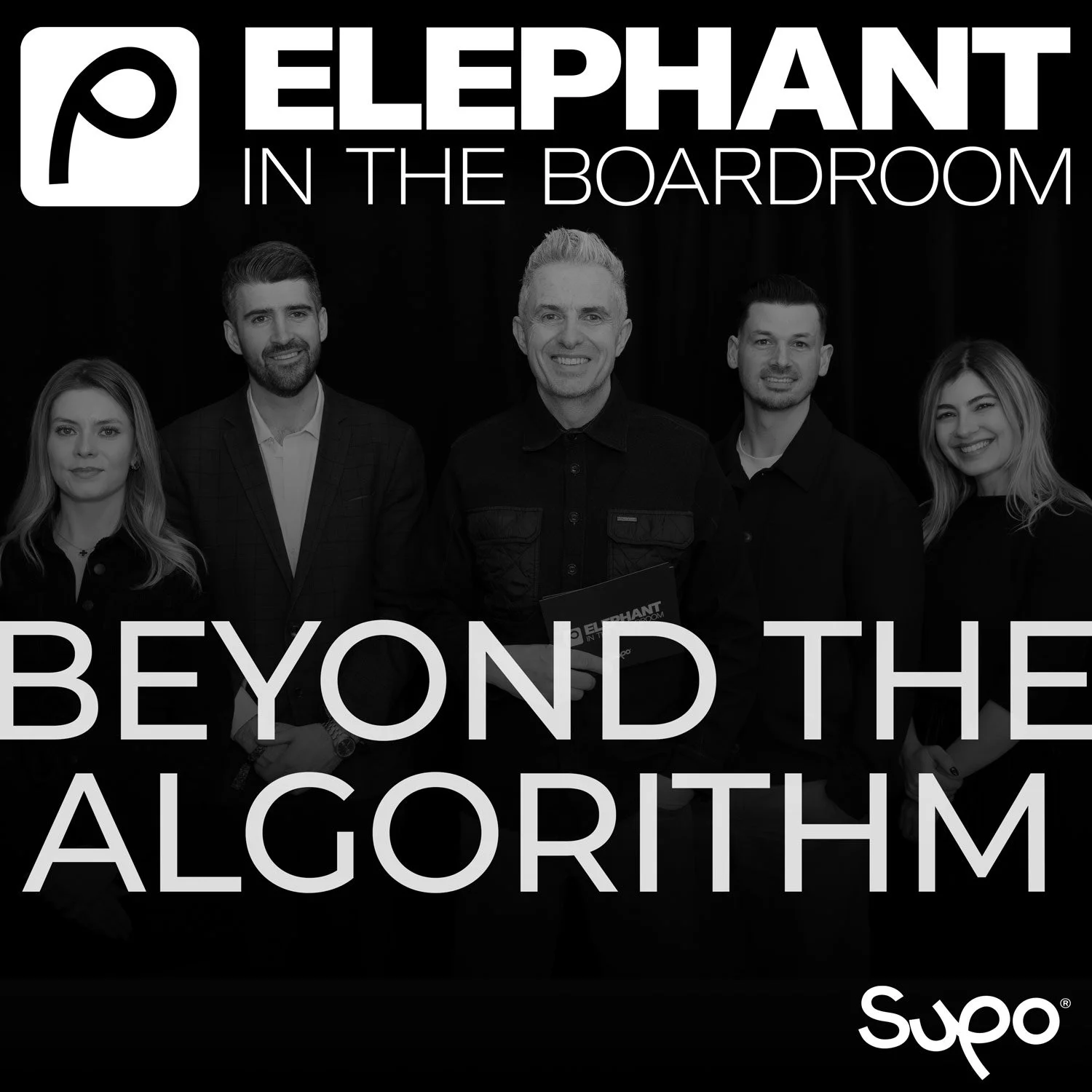
BEYOND THE ALGORITHM - Joel Williams, Simon Brading, Jemima Myers & Alice Johnston
Episode 5 - ELEPHANT IN THE BOARDROOM
Every platform has an algorithm. The question that opened this roundtable was simple: do you follow it, beat it, or ignore it entirely?
Four guests sat down with host Jim Johnson, and each one had landed on a completely different answer. Joel Williams builds on transaction data. Alice Johnston builds on creator intelligence. Simon Brading builds on handwritten letters and phone calls. Jemima Myers builds on search behaviour. None of them are wrong. That's what made the conversation worth having.
The Data That Doesn't Lie
Joel Williams' business runs on Mastercard's first-party transactional data, granular enough to show which postcodes are actually spending money, not just clicking on ads. His argument is that most of the advertising data market is saturated with contextual and behavioural strategies that never quite connect back to whether someone actually bought something.
"We enable advertisers and agencies and ourselves to activate against those audiences to see whether or not there was an uplift in sales or conversion based data."
With over 450 advertisers working with the business daily, and clients including Amazon and Coca-Cola, the model leans heavily on competitor targeting, building data sets that reveal whether a consumer has been shopping with a rival brand, then measuring whether targeting them actually shifted behaviour. It's not about beating the algorithm. It's about routing around it entirely.
Creators as Intelligence Systems
Alice Johnston takes a different view of the same problem. Her approach, which she calls creator intelligence, treats creators not as content channels but as intelligence systems in their own right.
"They are not just transmitting the content. They are basically intelligence systems for the brands."
The methodology runs on four principles: cultural sessions that bring brands and creators into a room before any content gets made, a platform that helps match creators faster, third-party optimisation once campaigns are live, and a proprietary measurement system built by her BI team. Underneath all of it sits a tagline that doubles as a philosophy: crave for people. Real events, real connection between creators and brands, not just algorithmic matching.

The Human Algorithm
Simon Brading went in the opposite direction entirely. In a world of LinkedIn messages sent to 1,500 people at once, he decided the only way to cut through was to become impossible to ignore, one handwritten letter at a time.
"I spent £20 on Amazon, bought some really nice paper, bought a nice Parker pen and just wrote to some dream companies."
It sounds inefficient, and in some ways it is. But Simon runs a 24-person agency working with major household names, built almost entirely on relationships rather than volume. The letters aren't a gimmick. They're paired with structure: tracking every outreach, learning conversion numbers at every stage of the pipeline, treating the "human first" approach with the same rigour most agencies reserve for their media buying.

Forget the Algorithm
Jemima Myers' agency, which started in Brazil before expanding to the UK, built something they call search for social media, born from a simple realisation: the moment you start optimising for an algorithm, you're already two steps behind it.
"The algorithm is designed to cater for their end customer... if you follow the algorithm, which is following the end user, you're two steps behind. What you need to do is look at the end user first."
Rather than targeting by demographic, the approach targets by intent, treating a piece of content the way a search engine treats a query, and asking what the best possible answer looks like regardless of who's asking. It's a subtle but significant shift: from guessing who the audience is, to answering what they actually want to know.

Where It Leaves the Room
Four different starting points, and the same underlying question: as attribution gets harder to track and the customer journey gets messier, what do you actually build a business around? Transaction data, creator relationships, human connection, or search intent? The roundtable didn't land on a single answer. It landed on the case for all four existing at once.
About Supo:
Supo provides people-first intelligence software for professional services firms, helping businesses maximize profit and motivate their people through powerful, AI-enabled business intelligence dashboards. By connecting over 500+ platforms and providing real-time data analysis, Supo helps firms make better data-driven decisions about their profit, projects, and people.
For more information about Supo: www.supo.co.uk
About Joel Williams, Transact Media Group:
Joel Williams is founder and CEO of Transact Media Group (TMG), a transaction-driven media and data company that enables brands to target, activate and measure real consumer behaviour at scale. Rather than relying on the proxy-based targeting that dominates much of the advertising data market, TMG builds on deterministic transaction data, including Mastercard's first-party spending data, to activate high-intent audiences and attribute media exposure directly to real sales outcomes. TMG works with over 450 advertisers, including Amazon and Coca-Cola, spanning retail, ecommerce and travel.
For more information about Transact Media Group: https://www.transactmediagroup.com/
About Alice Johnston, LOI:
Alice Johnston is founder and MD of LOI, a global creator marketing agency built on the principle that campaigns work best when they're run by people who are native to the creator space, not agencies who simply hire creators after the fact. LOI pairs creator fluency with data-backed strategy, running cultural sessions that bring brands and creators into the same room before any content is made. The agency has worked with brands including Bentley and Magnum, and has been recognised with multiple TikTok Creative Partner Awards.
For more information about LOI: https://www.loi.digital/
About Simon Brading, Brightec:
Simon Brading builds enterprise partnerships at Brightec, a multi-award-winning UK mobile app development agency. Brightec has delivered for clients including Jaguar Land Rover, Morrisons and Willis Towers Watson, with a culture built on curiosity, long-term relationships and putting people first at every stage of the process.
For more information about Brightec: https://www.brightec.co.uk/
About Jemima Myers, Social Chameleon:
Jemima Myers is founder and CEO of Social Chameleon, a Search-First Social Media agency and winner of Social Media Agency of the Year and Digital Agency of the Year. The agency pioneered an approach that treats social content the way a search engine treats a query, optimising for user intent rather than platform algorithms, and works with global brands including Xiaomi and Marriott alongside major sporting activations spanning F1, La Liga and the World Cup.
For more information about Social Chameleon: https://socialchameleon.com/
If the algorithm is never going to be transparent, is the real skill learning to read it, or learning to work entirely outside it?