
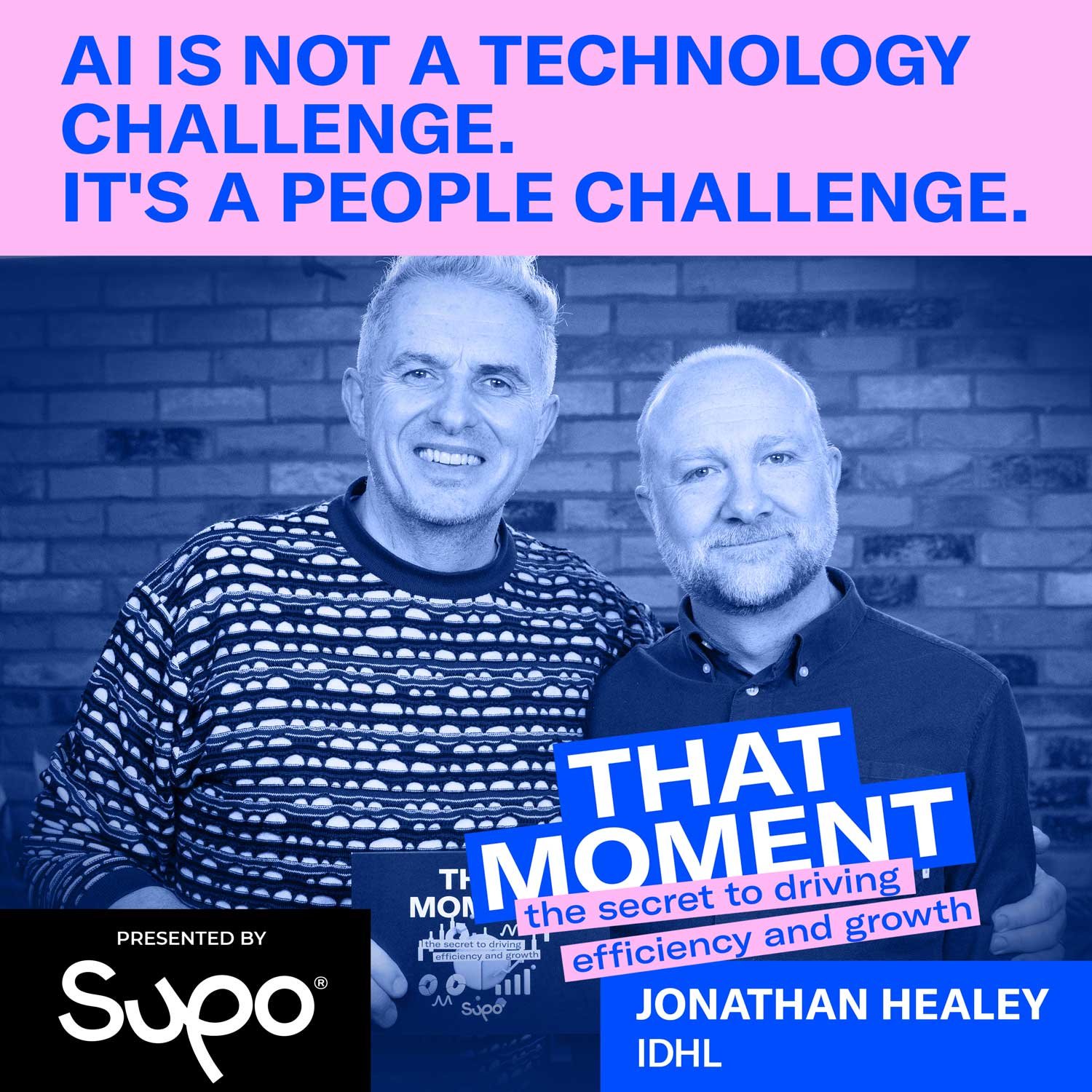
"AI is not a technology challenge. It's a people challenge" - Jonathan Healey, IDHL
Episode 19 - THAT MOMENT
Some careers are built by starting companies. Others are built by staying, evolving, and taking responsibility when it matters. Jonathan Healey has led through acquisition, growth, and reinvention - and at each stage, his role has changed. This episode is about the moments that forced him to redefine himself.
Jonathan Healey is Group Technology Director at IDHL, a role he stepped into after being MD for over a decade. But his journey started far from Yorkshire boardrooms. He began in South Africa during Y2K, driving 10,000 miles in seven weeks installing servers for a bank, trying to avoid millennium chaos. He worked on what was then the southern hemisphere's largest consumer portal - 2 million subscribers, 400,000 daily active mailboxes. Facebook didn't exist yet. Gmail didn't exist yet. And somehow, he ended up leading that dev team.
Then in 2007, Jonathan and his wife made a decision that changed everything. They met some South Africans at a leadership conference in Germany who said they were moving to the UK to start a church. Jonathan and his wife thought: we'd love to do that. Five days in a bed and breakfast in York, suitcases in hand, starting their lives over. He was 28. They built a church community before he built a business. He joined an agency straight away - had to eat - and 18 years later, he's still with that organisation, though it's evolved and changed dramatically.
There's a correlation between risk and faith that runs through Jonathan's story. Leaving security in South Africa to start a church in Yorkshire. Staying when the founder sold the business and becoming MD of a loss-making agency at 33. Stepping away from MD after a decade to focus on AI and technology strategy when most people would cling to the familiar role. Each moment required faith - not religious faith exclusively, but faith that the bigger goal, the bigger reward, the bigger outcome was worth the leap.
Now as Group Technology Director, Jonathan leads technology strategy and AI innovation across IDHL. And his central conviction? The whole AI thing is not a technology challenge. It's a people challenge. Tools matter. But democratising knowledge, building culture, understanding that humans will use technology more than ever - that's what determines whether AI becomes opportunity or distraction.
This episode tackles the uncomfortable question every agency leader faces: when do you stay and evolve, and when do you leave? And what does it cost to redefine yourself when you've spent years mastering one role?
The Reality of Staying and Evolving:
Leadership Influence Is Unintentional: About a month after Jonathan became MD, a lady who handled debt collection pulled him aside. She came into the office once a week, worked mostly from home. She said: the whole atmosphere in this business is different. Jonathan realised immediately - the leader at the top has massive influence, even unintentionally, on the environment they're involved in. A huge part of his role was curating an ecosystem and culture, not just systems and processes.
Second Generation Leadership Is Rare: Jonathan finds very few second-generation leaders still present and active in executive teams in this industry. Lots of founders who stay. Lots of founders who exit. But second generation leadership is a real challenge. Often if the talent is there, it gets frustrated and sets out on its own - because they can't break glass ceilings, or because the business is someone else's lifestyle, not theirs.
Capacity Requires Boundaries: Jonathan doesn't respond to emails on weekends or after he's logged off unless there's extreme circumstances. He'll work to 7pm, 8pm if needed, but once he's done, he's done. Once he's done Friday, he's done until Monday. He checks - as a leader, if something crops up that's an emergency, you have to be always on. But he doesn't need to deal with it. Boundaries aren't optional. They're essential.
Optimisation Drives More Than Money: What drives Jonathan more than anything is the satisfaction from heavily optimising something - the flow of work through an agency, the profitability of that agency. That's driven him more than seeking a big paycheck, seeking a lifestyle, or seeking autonomy from striking out on his own.
Bringing Five Agencies Together Is Hard: When IDHL merged several agencies under one banner, the systems were hard enough. But the people's side - bringing together different cultures - is really, really challenging. It's easy to underestimate the impact on individuals, no matter how much you've planned for it.
Stepping Away Requires Trust: When Jonathan transitioned from MD to Group Technology Director, he handed over to Claire - someone he'd worked with for 15 years, who'd been part of his management team for ten of those years. She comes with energy, enthusiasm, new ideas, vision, ability to implement at pace. His approach? Step in when invited. If he has a perspective, take it to a forum ideally only with her, so she can take it or leave it. Nobody wants to feel like the previous MD is secretly pulling strings.
Leadership Lessons Learned:
Why understanding the connection between headcount, revenue, and productivity matters - most agencies at the smaller end (up to about 100 people) struggle with this. IDHL had quite a good structure early for forecasting ahead and predicting resource needs. You always end up in pinch points, but structure helps.
How the numbers you carry in your head define leadership focus - Jonathan had four numbers as MD: revenue, profit, WIP (how much work contracted), and weighted sales pipeline value. He carried them in his head constantly and always prepared his own KPI presentations to grapple with the numbers properly.
The agency land challenge of being very analytical and numbers-driven - IDHL has this culture because it was born from SEO success, which is all about positions, keywords, data. That analytical foundation creates clarity about utilization, capacity, pipeline - everything measurable matters.
Why AI isn't replacing functions, it's becoming critical parts of functions - AI works better as a component of workflow. Wherever a decision needs to be made, something needs evaluating or classifying, AI performs brilliantly. But letting it handle entire business automation? That's asking a random number generator to run your business.
The democratisation imperative - when you make one person responsible for AI, the risk is locking all knowledge inside one person. Jonathan sees a huge part of his role as democratising that information across the business, not hoarding it.
The buying vs building question for agencies wanting to scale - buying businesses is hard. Hard to find the right one, negotiate the right one, integrate the right one. But the payoff is huge. If while you're doing that you can be building, you've got the winning formula.
From Jonathan's perspective as someone who started installing Y2K servers and ended up Group Technology Director 25+ years later, witness how staying isn't stagnation - it's evolution. He joined an agency in 2007, went through acquisition, became MD of a loss-making business at 33, turned it profitable, grew it fourfold over ten years, became joint MD of five merged agencies, then stepped away from day-to-day leadership to focus on what the business needed next: unified technology strategy and AI innovation.
Jonathan shares what he's learned about the connection between risk and faith: you take risks because you've got your eye on some bigger goal, bigger reward, bigger outcome. Whether it's starting a business for independence, starting a church because you think you can make a difference in a community, or stepping away from MD because you realise what you're doing will no longer bring life and possibility - until a colleague says "I think you'd be great at this" and plants the seed that changes everything.
This episode addresses the question every agency professional wrestling with their next move asks: is success about jumping to the next company, or is it about staying long enough to evolve through the stages that matter?
About Supo:
Supo provides people-first intelligence software for professional services firms, helping businesses maximise profit and motivate their people through powerful, AI-enabled business intelligence dashboards. By connecting over 500+ platforms and providing real-time data analysis, Supo helps firms make better data-driven decisions about their profit, projects, and people.
For more information about Supo: www.supo.co.uk
About IDHL:
IDHL partners with organisations where growth is complex and marketing carries real commercial weight. For 25 years, they've helped brands decide what to prioritise, where to invest, and how to connect demand, experience, and conversion into systems built for growth. Through IDHL Labs, their technology incubator, they test and apply AI and automation in real-world conditions - developing tools with clear guardrails so work becomes more efficient and performance improves in measurable ways. The focus stays on commercials and continuous improvement: results you can see, measure, and sustain.
For more information about IDHL: https://www.idhlagency.com/
Ready to discover why the most successful careers aren't always about starting something new? This episode isn't about founder stories - it's about the leadership transformation required when staying becomes the bravest move you can make.