
Episode 1 - ELEPHANT IN THE BOARDROOM
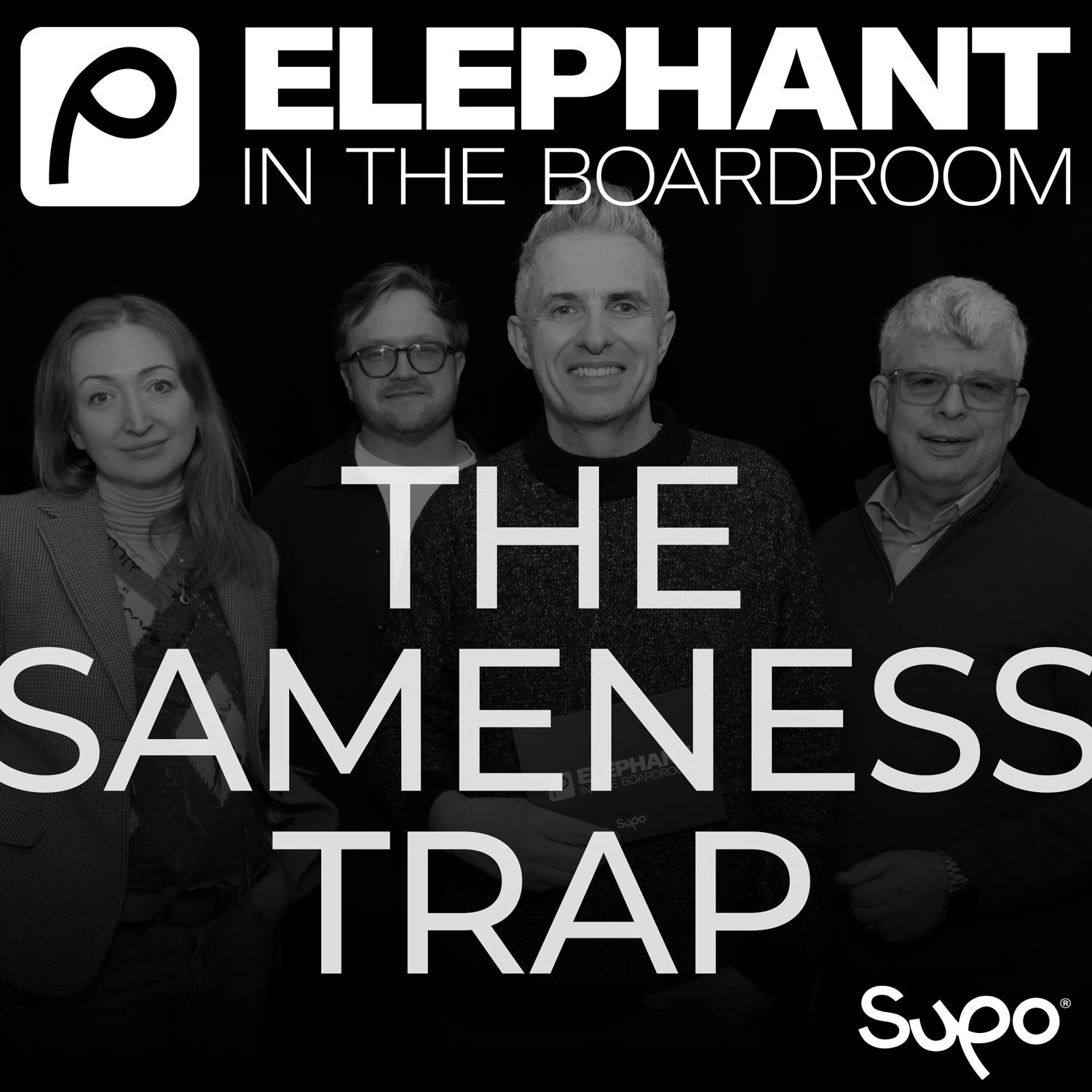
Elephant in the Boardroom is a different format. No solo interviews. Instead, senior leaders from three different agencies sit down together and tackle the question everyone's afraid to answer honestly: if every agency looks the same, what gives you the right to win?
The first episode starts with a simple observation from Jim Johnson, the host: most agencies are trapped in a game they didn't design and can't win. They diversify because clients ask them to. They compete on price because they can't prove value any other way. They look, pitch, and behave identically to the agency five blocks away.
But these three aren't trapped. And they got out in completely different ways.
Jeremy Stern built PromoVeritas 25 years ago by doing the opposite of every agency trend. While the industry was diversifying, he narrowed. While competitors were chasing every client, he turned business away. Today, 60% of his revenue comes from clients who've been with him more than a decade. He's the specialist other agencies bring in because they can't replicate what he does. He doesn't compete on price. He barely has to pitch.
Scott-Ashley Whiteley operates at the opposite end of the spectrum. Blott works across three verticals - GTM, digital experience, innovation - and is building an agentic operating system for its own agency. To an outsider, that looks broad. To Scott, it's coherent. He believes this is the greatest opportunity in the history of the industry. His differentiator isn't narrowness. It's conviction combined with storytelling - the ability to take complicated business problems and make them felt.
Alona Malinovska operates in a completely different model. Webgains Global doesn't charge clients the way traditional agencies do. It charges on outcomes. It connects brands with publishers as a payment mechanism, not a marketing channel. She watches consumer discovery shift in real time - from Google, through social and influencers, and now through AI tools. Her version of not being trapped is built on accountability and measurement.
Three agencies. Three different strategies. One shared conviction: the sameness trap is real, and the way out isn't to do what everyone else does, just better.
The Narrow Way: Specialisation as Moat
Jeremy started by spotting something the industry was abandoning. Promotions - the mechanics of running prize draws, compliance, legal structure across international markets - was disappearing inside bigger agencies. Everyone was getting broad. He went deep.
Twenty-five years later, that decision defines everything about PromoVeritas. He has 250 clients across 90 countries. He doesn't spend money on pitching because his reputation does that work. When new business approaches, the conversion rate is high because they already know what they'll get. When a bigger client asks if PromoVeritas can also handle media planning or social strategy, the answer is no. And that no is precisely what protects the business.
The narrow way works because it answers a question clients stop being able to answer themselves: when you specialise deeply, when you refuse to diversify, when you say no to adjacent services, you're not narrowing your market - you're widening your authority. You stop being a generalist they might call for advice. You become the specialist they bring in because no one else can do what you do.
This protects you from the sameness trap because you're not competing on the same terms. You're not pitching against five agencies offering five versions of the same thing. You're the only game in town in your space. And clients who know that space, who understand the value, will pay for depth over breadth every time.
The sacrifice is real. You say no to revenue. You say no to growth opportunities. You stay focused when the industry tells you to expand. But what you gain - trust, retention, authority, pricing power - compounds.
The Storytelling Way: Conviction as Differentiator
Scott takes a different view. He doesn't believe the answer is to narrow. He believes the answer is to know what you're actually good at, to commit to it completely, and to build systems around it. Blott works across three verticals because those three verticals - GTM, experience, innovation - are three entry points into solving the same problem: how to help ambitious businesses tell their story to the people who need to hear it.
The through-line isn't the services. It's the belief. Scott thinks storytelling is the ultimate differentiator. Not copywriting. Not content strategy. Storytelling - the human ability to take something complicated and make it felt, to connect emotion to business outcome.
The conviction matters. When Scott pitches, he's not pitching a service menu. He's pitching a point of view about what agencies are actually for. That conviction attracts different talent - specialists who believe in the same thing rather than generalists collecting a paycheck. It attracts different clients - ones who understand that storytelling is worth paying for.
The sameness trap comes from agencies that look the same because they lack conviction. They offer everything because they don't know what they're good at. They optimize for growth because they don't believe in the work. Scott escapes that trap by being willing to say: we believe in this one thing so completely that we've built the entire business around it. That's unfair to the competition because it's not actually competition - it's a completely different game.
Building an agentic operating system - essentially, automating your own processes - is part of the same philosophy. You prove that you understand the problem so deeply that you can solve it with tools. You become the client's proof point that the work you're selling actually works.
The Performance Way: Results as Truth
Alona's escape route is the most radical because it changes the commercial model entirely. Webgains doesn't work on a fee-for-service basis. Brands pay on results. They pay a commission when the affiliate generates a sale. That's the fundamental difference between Webgains and every agency that competes on price or reputation - results are measurable, and payment is tied to outcome.
This solves the sameness problem at its source. You can't be interchangeable if you're only paid for what works. You can't compete on price if the only price that matters is the one that comes after results. You can't look the same as other agencies because the conversation with clients is completely different. It's not "what will you charge us" - it's "what can you actually drive."
Alona is also watching something happen in real time that most traditional agencies haven't fully recognized: consumer discovery is shifting faster than strategy can keep up. Five years ago, product discovery happened on Google. Now clusters of users are starting on ChatGPT and Gemini. The platforms are changing. The payment models that work are changing. The traditional agency model - which assumes relatively stable channels and relatively stable client relationships - is becoming fragile.
The performance model survives that fragility because it doesn't rely on predicting channels. It relies on results. If discovery shifts from Google to AI tools, the model doesn't break - the mechanism adapts. You find where customers are being convinced and you connect brands to publishers there. The payment stays the same. Only the mechanism changes.
What Connects Them
On the surface, these three strategies look incompatible. Narrow versus broad. Storytelling versus measurement. Premium positioning versus performance-based. But they share something deeper: a willingness to play a different game rather than compete at the old one.
Jeremy says no to diversification because he knows depth compounds. Scott says this is the greatest opportunity in history because he believes in the work. Alona changes the entire commercial structure because she trusts results. None of them are trying to be better at the game every other agency is playing. They're not competing on price because they're not competing on the same terms at all.
The sameness trap catches agencies that try to be good at everything, that compete on service breadth, that optimize for client acquisition because they lack client retention, that hire generalists because they lack conviction. The three ways out of the trap - go narrow, build conviction around one skill, or tie your success to measurable results - are just different expressions of the same principle: be willing to be worse at something so you can be irreplaceable at something else.
About Supo:
Supo provides people-first intelligence software for professional services firms, helping businesses maximize profit and motivate their people through powerful, AI-enabled business intelligence dashboards. By connecting over 500+ platforms and providing real-time data analysis, Supo helps firms make better data-driven decisions about their profit, projects, and people.
For more information about Supo: www.supo.co.uk
About PromoVeritas:
Jeremy Stern founded PromoVeritas 25 years ago to become the specialist in international promotions, prize draws, and promotional compliance that the industry had abandoned. Working across 90 countries with 250 clients, he's built a business where retention drives growth and authority replaces pitching. Over 60% of PromoVeritas revenue comes from clients who've been with the agency for more than a decade. His philosophy is built on deep curiosity, genuine expertise, and the commercial clarity that comes from refusing to diversify.
For more information about PromoVeritas: www.promoveritas.com
About Blott:
Scott-Ashley Whiteley founded Blott on the conviction that storytelling - the ability to take something complicated and make it felt - is the last truly differentiating skill agencies have. Working across GTM, digital experience, and innovation, Blott works with ambitious businesses in music, fintech, FMCG, and private equity. Scott is building an agentic operating system for his own agency - using Blott as the proof point that the capabilities he sells to clients actually work. His philosophy: 50 passionate specialists beat 200 indifferent ones every time.
For more information about Blott: www.blott.com
About Webgains Global:
Alona Malinovska leads Webgains Global, a performance-based platform that connects brands with publishers across 80+ countries. Rather than operating as a traditional agency, Webgains charges brands on commission - they pay only when results happen. Alona watches consumer discovery shift in real time: from Google to social and influencers to AI tools. Her philosophy: accountability through measurement, and the belief that the commercial model should reflect reality rather than obscure it.
For more information about Webgains Global: www.webgains.com
The sameness trap is real. But these three agencies have found three completely different ways out. The question isn't which way is right - it's which way is right for you.