
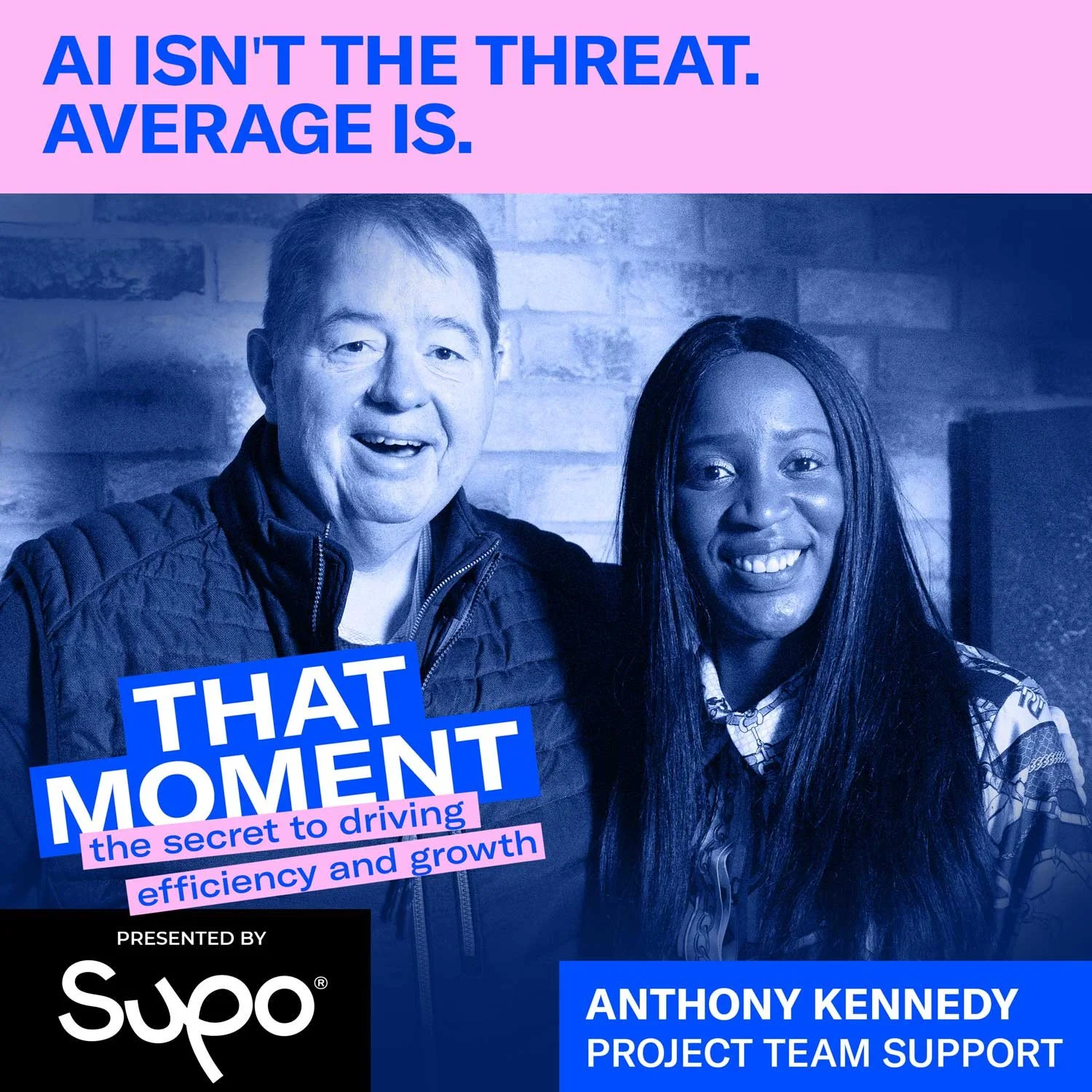
AI isn't the threat. Average is. - Anthony Kennedy
Episode 24 - THAT MOMENT
Most conversations about AI in marketing start with fear. Will it replace me? What happens to my team? How do I stay relevant?
Anthony Kennedy doesn't start there. He starts with a different question: What work is actually worth doing?
His career has been built inside global organisations. Goldman Sachs in the late 90s, where he fell into an in-house agency role and discovered how deeply you can understand a brand when you're inside it. KPMG, where he built their in-house capability from the ground up. ION, where he scaled an internal creative services function called Impact across 13 offices, 11 time zones, and 15 specialist teams.
Then he stepped away. Earlier this year, Anthony made the choice to work independently - advising senior leaders on AI adoption, in-house team design, and the future of marketing roles. It's the kind of move that only makes sense if you've already figured out what you're actually good at.
And he has. Deeply.
What Anthony has learned through his career - and what he's now using to advise other organisations navigating AI - is that the threat isn't what everyone thinks it is. The threat isn't AI. The threat is average work. And AI has already replaced it.
His reference point comes from David Droga, the legendary creative leader who recently gave an exit interview where he said something that landed hard: "AI has already replaced. It's better than average. Nobody should be trying to save the average." This isn't doom. It's clarity. If AI can do average work better than humans can, then the conversation shifts. The question stops being "how do we protect average work" and becomes "how do we do work that AI can't do."
For Anthony, that's where the real leverage sits. Not in fighting technology. In understanding what technology can't touch - and building teams and organisations around that.
The episode covers the practical reality of this shift. Anthony talks about building in-house teams at the scale he managed at ION - and why in-house agencies matter more now than ever. He talks about the difference between pressure and stress, and why most leaders confuse the two (spoiler: it's about whether you have your task list under control). He shares his hiring principle - "don't hire a**holes" - and why that rule has held across every organisation he's worked with.
But the core of this conversation is about the tools themselves. Anthony uses AI deeply and daily. Six apps on his phone that he engages with every single day. ChatGPT with custom GPTs built around his Gallup Strengths Finder results, so every query comes back with advice tailored to his strengths and guidance on what to delegate. Claude for specific types of creative work. Mistral to create prompts for other AI platforms. Gemini. ProtonLumo with integrated file storage so he can capture ideas on the move and have his AI projects reference them next time he returns.
This isn't theoretical. This is someone who's thought about how to work in this era and is now building the infrastructure to do it well.
The uncomfortable truth he keeps coming back to: 94% of companies are adopting AI into their workflows. Only 6% of people have been formally trained on it. That gap is where the real problem sits. Not the technology. The preparation. The training. The clarity about what you're actually trying to do with these tools.
This episode is for leaders who feel the shift happening and aren't sure where to stand. It's for marketers who know average work is disappearing and wondering what that means for their career. It's for anyone trying to figure out whether they're under pressure (which is manageable) or stress (which breaks you), and whether they've actually got the fundamentals right - clean data, good systems, people who know what they're doing.
Anthony doesn't have all the answers. But he's asking better questions than most. And his experience building inside complex organisations has taught him what actually matters when the work changes.
When Pressure Becomes Your Advantage:
The difference is in your task list. Most leaders use "stress" and "pressure" interchangeably. Anthony learned that they're fundamentally different things. Pressure is manageable. Stress is what happens when you lose control of your task list. It's the difference between knowing what you need to do and feeling overwhelmed by it. He's a student of David Allen's Getting Things Done methodology - mapping out projects, defining end states, identifying the next step. The pressure stays intense, but the stress disappears because you know what you're actually working towards.
Your people matter more than your tools. In-house agencies get built on the assumption that you know your organisation, your brand, your people. External agencies bring fresh perspective from working across clients. Both matter. But what Anthony discovered through his career is that retention and deep understanding compound. When you have team members who've stayed with one organisation through multiple cycles, they understand the commercial logic in ways that rotate-through contractors never will. The investment in people is an investment in capability.
Don't hire a******s. It's his first rule, and it's the one that echoes across every organisation he's built. The work matters more than the top performer who gets to break rules. Take care of your people. Give them opportunity to grow. Help them understand the purpose behind what they're doing, not just the job description. Reward them when you can. And be clear: we're not perfect, but we know where we're trying to go.
AI is a threat to average, not to you. The reframe is crucial. If you're doing work that's replaceable by AI - routine, repeatable, pattern-based - then yes, it's threatened. But if you're doing work that requires observation, perspective, judgment, talent - the things that come from experience and human discretion - then AI is a tool that amplifies what you do, not a replacement for you. The talent, the skills, the perspective that you bring as a team is greater than AI. Keep believing that.
What Actually Changes:
The tools are only as good as your fundamentals. Anthony spends time with CMOs and marketing leaders, and the pattern he sees is consistent: organisations try to adopt sophisticated martech stacks without having their basics right. Clean data. Single source of truth. Zero-touch data access. Systems connected well. And the ability to remove things from your tech stack that no longer serve you. The martech landscape had 143 vendors in 2010. It now has nearly 20,000. You can't test them all. You have to pick trusted partners and build long-term relationships. Same with AI. Pick your horse. Stay on your horse. Master the platform. Move on.
Training is the multiplier. 94% of organisations are adopting AI. 6% have formally trained their people on it. That gap is where the competitive advantage sits. Anthony doesn't expect every leader to become an AI expert. But he expects teams to have basic confidence and competence with the tools they're using. The quicker people get some fundamental skills and some confidence, the quicker they start bringing ideas, making suggestions, testing and trialling things. Training isn't a cost. It's a multiplier.
If your leader isn't training you, train yourself. This is the point Anthony makes directly to individual contributors listening. If your agency leader or in-house team leader isn't investing in AI training for you, that's information. You can wait, or you can be self-motivated. You can download Claude in 30 seconds. There's no excuse for not getting the basics right, and no one else is responsible for that education except you.
The future of marketing is about removing the average. Most job descriptions today include work that's going to be automatable. Marketing roles of the future won't disappear - they'll change. The routine parts go away or get automated. The parts that require human judgment, observation, and perspective stay. The question is: what parts of your current role would survive if all the average work was automated? And are you building your career around those parts, or around the stuff that's going away?
From Anthony's perspective as someone who's built in-house teams at scale and is now watching the same challenges play out across the industry, the shift is real but not catastrophic. It's a turning point, like every other turning point - the advent of computers, the internet, the rise of mobile. People had to adapt. People will adapt again. But adaptation requires confidence, training, and the willingness to stop trying to save work that machines can do better.
What Works in Practice:
Culture eats everything else. The hiring principle - don't hire a**holes - sounds crude until you realise what it actually means. It's not about being nice. It's about recognising that the work matters more than the individual brilliance of one person who gets to break rules. When you prioritise character and culture fit, teams stay longer. They grow deeper. They understand the purpose behind what they're doing. Everything else - training, retention, performance - becomes easier when the culture is right.
Systems enable people, not the other way around. At scale, it's not about finding one brilliant person. It's about building infrastructure that allows many good people to do good work across multiple geographies and time zones. That means clarity about what the work is. Processes that work. Teams that know what they're actually trying to accomplish. This doesn't happen by accident. It requires thinking systematically about structure, and the role of people within it.
Focus beats optionality. In martech, in AI, in any technology landscape - there are too many options to test them all. The winning move isn't to experiment with everything. It's to pick your core platforms, master them deeply, and don't get distracted by every new vendor. Same with AI tools. Pick the platform that works for your thinking, get genuinely good at it, build infrastructure around it. The depth matters more than the breadth.
About Supo:
Supo provides people-first intelligence software for professional services firms, helping businesses maximize profit and motivate their people through powerful, AI-enabled business intelligence dashboards. By connecting over 500+ platforms and providing real-time data analysis, Supo helps firms make better data-driven decisions about their profit, projects, and people.
For more information about Supo: www.supo.co.uk
About Anthony Kennedy:
Anthony Kennedy is an Australian-born marketing and brand strategist with 25 years of experience inside global organisations including Goldman Sachs, KPMG, and ION, where he served as Chief Marketing Officer for over three years. He now works independently through Project Team Support, advising senior leaders on AI adoption, in-house team design, and the future of marketing roles. Over his career, Anthony has built in-house creative services functions at scale, led global marketing teams across 13 offices and 11 time zones, and developed a reputation for combining strategic clarity with operational excellence. He writes about the discipline and craft of marketing at anthonykennedy.com, and is a regular speaker and judge at industry events including the Oystercatchers Awards and the BIMA 100.
For more information about Anthony Kennedy: https://www.anthonykennedy.com/
Ready to discover why the hardest decisions often lead to the strongest growth? This episode isn't about morality. It's about what actually works - when you have the courage to find out.