
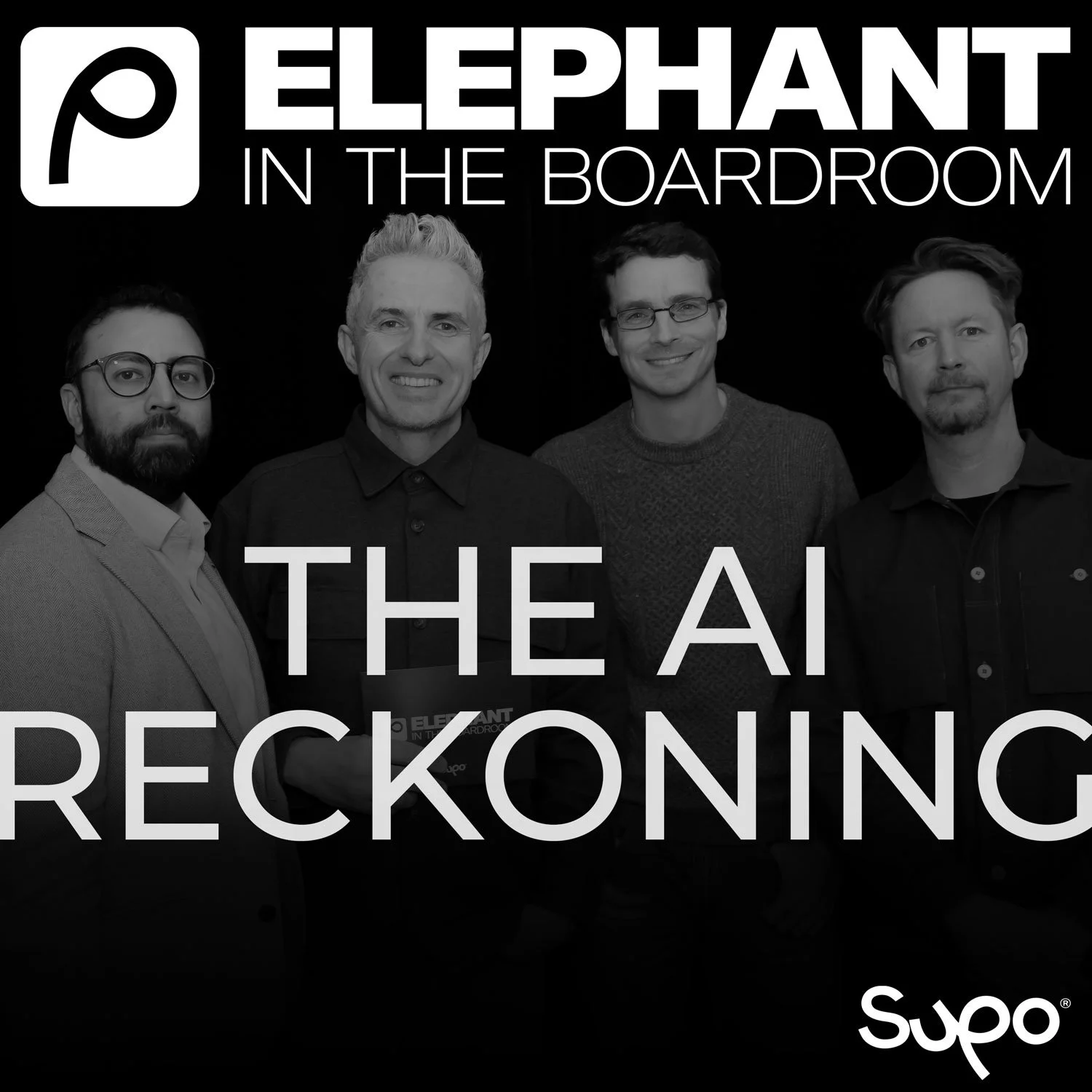
THE AI RECKONING - Raj Bawa, Jonathan Boakes & Chris Maslin
Episode 4 - ELEPHANT IN THE BOARDROOM
The conversation about AI has gone everywhere except the place it actually matters: governance.
Boardrooms are excited. Marketing teams are experimenting. Finance departments are calculating efficiencies. And somewhere in the middle, something dangerous is happening. Employees are using ChatGPT on personal accounts with sensitive data. Companies are buying AI tools without understanding where their data goes. Legislation is decades behind technology. And nobody - literally nobody - has a clear answer to what happens when AI automation means you can do the work with half the staff.
That's the tension this episode explores.
Raj Bawa is co-founder and operations director of JBi Digital, a digital transformation agency where governance and user-centricity run through everything. But what separates Raj from the hype machine is something harder: he takes data security seriously. Not as a compliance checkbox. As a foundational part of how you actually work. He's seen what happens when organisations chase transformation, or AI, without understanding the security and governance implications. And it is scary.
Jonathan Boakes runs the UK arm of Infinum, a 400+ person digital agency that spent two years rebuilding itself around AI before offering to help anyone else do the same. He's been thinking about this longer than most, and what he's learned is blunt: the technology isn't the hard part.
"The most common AI conversation I'm having with clients this year isn't 'should we?' It's 'we did. Why isn't it working?'"
Chris Maslin runs Go EO, helping business owners transition to employee ownership trusts. He's built a business, handed it to his team, and now watches other founders wrestle with the exact tension AI creates: if you can make the business vastly more efficient - and more profitable - but it means cutting headcount, what do you do when your staff are the shareholders?
Together, these three are pointing at something the AI hype has completely missed: the governance question isn't technical. It's human.
What You Can't See, You Can't Control
Start with Raj's opening: "What you can't see, you can't control."
It sounds simple. It's not. In a world where agencies are routinely sharing sensitive information - client data, strategic documents, proprietary processes - into AI tools they don't fully understand, it's everything.
The problem isn't the tools. It's the visibility.
"AI is everywhere" Raj explains. "Whether it's coding, whether it's people using elements of ChatGPT. But what people are putting in, what people are sharing - no one really knows."
So JBi Digital takes what Raj calls a risk-averse approach. Not risk-avoidant. Risk-averse. The difference matters.
"You need to know the tools you're using. Who's supplying those tools? Who's manufacturing those tools? Where are they based? Ultimately, where is your data?"
That means doing the work upfront. Understanding what data you have. Categorising what can be shared and what can't. Understanding which employees are using which tools and what they're prompting them with. And then - crucially - giving your staff clear guardrails. Not a ban on AI. Guidelines about what's safe to share and what isn't.
It sounds tedious. It's the opposite of the move-fast-and-break-things mentality that dominates tech culture. But Raj isn't wrong: you can only control what you can see. And most organisations right now are flying blind.
Shadow AI and The Permission Problem
Here's where it gets dangerous: the stuff happening in the shadows.
Raj calls it "shadow AI." Employees using ChatGPT on personal accounts because they want to get their work done faster. Uploading customer data, strategic plans, sensitive information - not out of malice, but because they're under pressure and the tool is in front of them.
One scenario Raj walks through: an employee putting customer records into ChatGPT because they need to create a user profile. Suddenly a thousand customer records are uploaded to an AI training system operated by a company you didn't authorize. The data is no longer yours. It's out there.
Jonathan adds another layer: "There's a real risk that means putting data that they shouldn't have done into ChatGPT or whatever it may be. And I can imagine there's going to be a lot of scalps in the next year. I can imagine if you're a senior in a law firm, they're probably going to be subtly encouraging their youngsters to really embrace these things. But then having in the back of their mind that if a big scandal comes out, that'll be someone who loses their job."
So how do you solve it? Not with fear. Not with bans. With permission.
But the wrong kind of permission - just saying "yes, use AI" - is how you end up with shadow AI. The right kind of permission is what Jonathan's team built: a framework.
"We built a framework internally where all of the developers were looking at different tools and we created a Slack channel for people to feed into that and understand and look at other people's reviews about specific models. The idea being: go and experiment, then report back, and as a business we'll funnel to the top what we think for each of the things."
It's not excitement. It's not fear. It's structure.
"Go and play with a set of toys, get some understanding, get some reality checks because it's not as amazing as you might have seen on a YouTube video. You've got to have that understanding so when you go into conversations, you have that understanding."
That's the permission framework. Not "do what you want." Not "don't touch it." It's: here are the tools we've approved, here's how to experiment safely, here's how to report back what you learn.
The Governance Gap
But here's the uncomfortable part: most organisations aren't doing any of this.
Raj has seen it in real time. "Larger organizations, they're all talking about it in the boardroom. Everybody wants to save money. Everyone wants to be ahead of the game. But what does that effectively mean? Boardroom conversations are leading to let's just chuck a lot of money at things, but actually no real thought process about adopting AI programs."
The pattern is predictable: company buys an AI tool, runs a pilot, appoints a Head of AI, then... nothing. The tool sits there. The team isn't trained. There's no monitoring. No controls. No plan for what comes next.
"Once you've taken that step, it's so important. They'll take all the assets for the first time, but then there's no monitoring and controls from that. And it's the continuous commitment to ensuring I'm going to be adopting AI and I'm going to be monitoring, and we're going to pivot and we're going to continue doing this. Improve. Improve."
This is where governance becomes a commercial issue, not a technical one. The organisations actually pulling value out of AI aren't the ones with the fanciest tools. They're the ones with tabletop exercises. With playbooks. With someone owning adoption. With measurement systems pointed at outcomes, not activity.
AI Scaffolding and Deep Thinking
Jonathan frames it differently: AI as scaffolding.
Not replacement. Not augmentation. Scaffolding - the building blocks that let you do the harder work faster.
"The idea here is that if you're allowing AI to do those more regular tasks, you still have the same amount of hours to complete whatever it is that needs to be delivered. So you have then had time freed up to allow you to think about complex problems in a deeper way."
That's the opposite of the automation anxiety narrative. It's not "AI will take your job." It's "AI will take the routine stuff so you can do the thinking that machines can't."
But - and this is crucial - it only works if your team actually embraces it.
"The people that are using these products have an opinion on the product. And really, without that, you're already at such a disadvantage. The teams we have are living in this world. They've watched this whole thing develop over the last few years and have been a big part of it."
So the question isn't whether to use AI. It's how to build a culture where your people are curious enough, skilled enough, and empowered enough to use it well.
The Employee Owned Tension
Then there's Chris's problem, which is more uncomfortable than anyone wants to admit.
Chris runs an employee-owned business. His staff aren't workers. They're shareholders. If the business gets more profitable, they all benefit. If it gets cut, they all hurt.
Now imagine: AI can cut your headcount in half and double your profitability. What do you do?
"For the individual, it's probably likely to be moving too fast, because you'll get in trouble, because you'll break rules. But then when you do that on a bigger scale, I think it's moving too slow. AI is coming whether we like it or not. If you just totally fight against it or stick your fingers in your ears and say la la la, then you may find that everyone in the business is out of a job."
It's the paradox at the heart of all this. The company that doesn't adopt AI might lose all its jobs to competitors. The company that adopts AI too fast might cut jobs to save money. Either way, people lose.
Chris doesn't pretend to have solved this. "Having said that, if you know the efficiencies are meaning that headcount needs to come down, which won't always be the case as you said, it can free people up to do other things, whatever those may be. Then yeah, potentially headcount will need to fall even in an employee owned organization."
But the person making that decision - in an employee-owned company - has to live with the people it affects. That changes everything.
Tabletop Exercises and Real Scenarios
So how do you actually govern this? Not in theory. In practice.
Raj describes tabletop exercises: sit down with your leadership team and ask: what's your ground rules? What's the most important part of your organization that you want to protect? What happens if someone accidentally uploads your entire customer database to ChatGPT? What happens if a cyber attack compromises your internal systems? What happens if a supply chain partner gets hit?
"We will look at tabletop exercises. We will sit down with organizations. What is an assessment? What's your ground rules? What's the most important part of the organization that's most sensitive that you want to protect?"
Then you play it out. You don't just talk about scenarios. You work through them. You build playbooks. You understand where your weak points are - and spoiler alert, it's almost always people.
"The AI world has gone in and out. Now, these are internal employees that are sharing credentials or internally a supply chain that uses credentials. It's behavioral change that will support resilience as a whole."
This is governance that actually works: not rules, but scenario planning. Not controls, but clarity about what you're protecting and why.
Moving Too Fast or Too Slow?
The final tension is the one Jonathan surfaces: are we moving too fast or too slow?
For individuals, the answer is clear. Move too fast, make a mistake with data, and you're the one who loses your job. Move too slow, and your organization falls behind.
But for nations? For industries? "You're never going to be right at the forefront of technology," Chris says. "But it must be really, really hard getting a balance between not wanting to be accused of being a nanny state and totally destroying entrepreneurialism, but equally somehow managing to stop the worst of whatever disasters could come."
The uncomfortable truth: "Legislation will never be able to keep up with technology." So governance can't wait for the government. It has to come from inside.
That's why culture matters more than rules. "It's culture, isn't it? Really? The culture breeds the culture. You know, this is a safe space that you're able to kind of play, make some mistakes, spend some money." But not reckless mistakes. Structured ones.
The Real Reckoning
This is where all three converge: the AI reckoning isn't about the technology. It's about whether you're governing it or just hoping it works out.
The companies that are winning with AI aren't the ones that moved fastest. They're the ones that did the boring work first: understood their data, built frameworks for experimentation, involved their teams, ran scenarios, built playbooks, monitored continuously. They're the ones that see AI as a tool to free people up for harder thinking, not a replacement for people.
And they're the ones that asked the hard question about governance before they needed the answer.
About Supo:
Supo provides people-first intelligence software for professional services firms, helping businesses maximize profit and motivate their people through powerful, AI-enabled business intelligence dashboards. By connecting over 500+ platforms and providing real-time data analysis, Supo helps firms make better data-driven decisions about their profit, projects, and people.
For more information about Supo: www.supo.co.uk
About Raj Bawa, JBi Digital:
Raj Bawa is co-founder and operations director of JBi Digital, a London-based digital transformation agency founded in 2008, with a focus on delivering digital platforms that are both user-centric and highly secure. Raj brings a risk-averse approach to AI adoption - not avoiding it, but understanding it. JBi's proprietary SecureSense™ framework ensures that organisations deploying AI do so with clarity about what data they're sharing, where it goes, and who controls it. JBi Digital works with leading global brands, public sector bodies, and non-profit organisations to solve complex digital problems through user-focused strategic consultation and technical implementation. The agency holds ISO 27001, Cyber Essentials Plus, and Crown Supplier Status certifications.
For more information about JBi Digital: https://www.jbidigital.co.uk/
About Jonathan Boakes, Infinum:
Jonathan Boakes is managing director of the UK arm of Infinum, a 400+ person digital agency with offices across the US, Canada, and Europe. Since 2005, Infinum has designed, built, and scaled software for top-tier brands including Philips, Porsche, and Leica - with solutions used by millions worldwide. Jonathan brings over 20 years of digital experience and a pragmatic view to AI adoption: it's not about the tools, it's about adoption strategy, measurement systems, and whether your teams have opinions about the products they're using. Infinum spent two years rebuilding itself around AI before helping other organisations navigate the same transformation.
For more information about Infinum: https://infinum.com/
About Chris Maslin, Go EO:
Chris Maslin is founder of Go EO, which specializes in helping smaller businesses (5-50 staff) transition to employee ownership trusts (EOTs) - easily and affordably. With deep experience in succession planning and exit strategy, Chris brings a unique perspective to governance questions: how do you manage technology decisions that make businesses more profitable but potentially cut headcount - especially when your employees are your shareholders? Go EO provides guidance on fair market valuation, succession planning, and governance structures that align founder prosperity with employee ownership.
For more information about Go EO: https://goeo.uk/
Your AI strategy won't survive contact with reality if you don't have governance. It's not about moving slower or faster. It's about moving with clarity. It starts with knowing your data, not hiding from it. With permission frameworks, not shadow AI. With tabletop exercises, not hope. With the human in the loop, not automation for its own sake. That's how you avoid the governance gap. That's how you actually deploy AI without breaking your business. The reckoning is coming. The question is whether you'll be ready.