
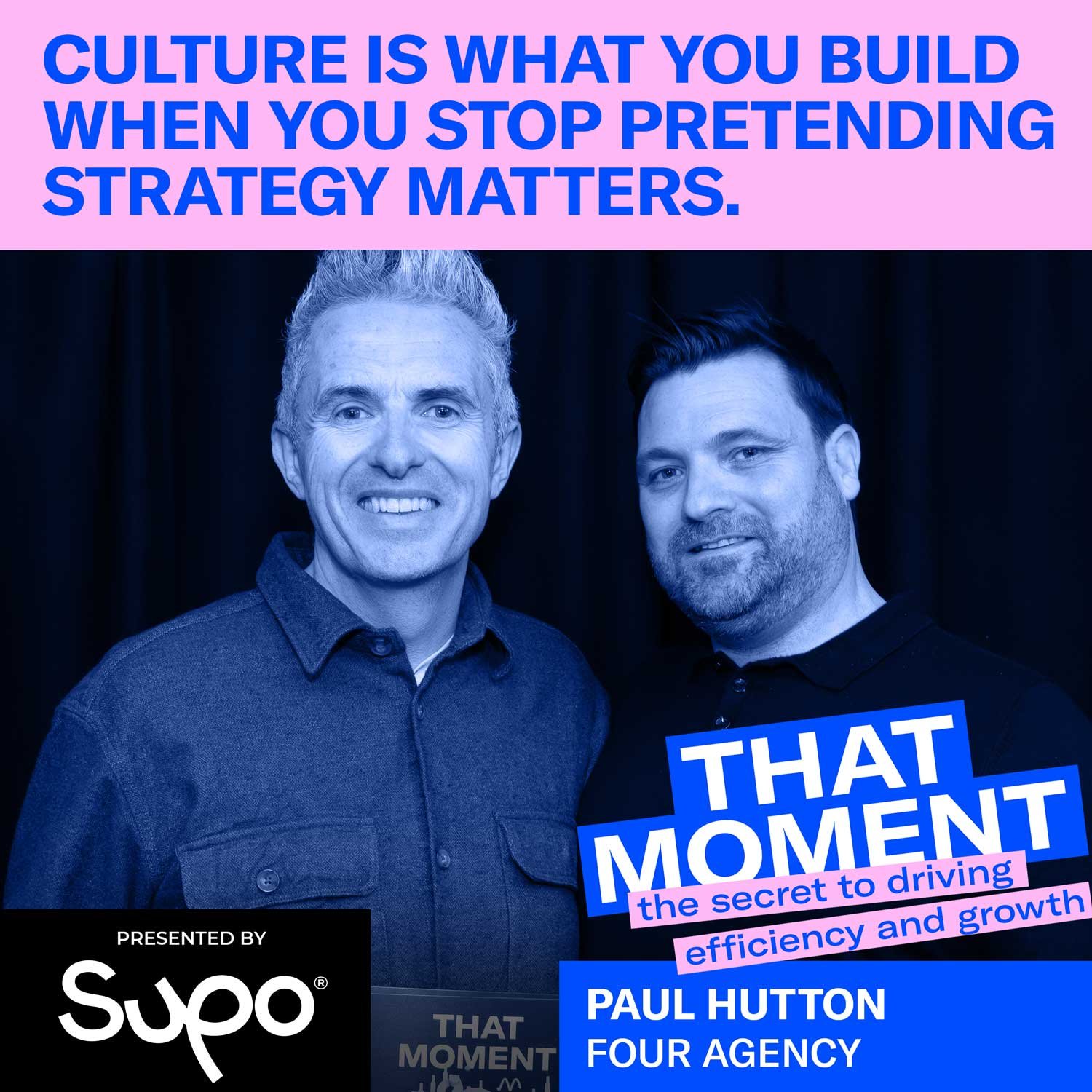
Culture is what you build when you stop pretending strategy matters - Paul Hutton, FOUR Agency
Episode 25 - THAT MOMENT
Most people who talk about culture in business are talking about strategy.
Better collaboration. Stronger alignment. Improved retention. Increased productivity. These are the words you hear at conferences, in HR decks, in carefully worded mission statements that no one reads.
Paul Hutton doesn't talk about culture that way.
When Paul walked into FOUR Agency three weeks before his conversation with Jim, the place was a graveyard of silos. People worked in boxes. Accounts were managed in isolation. No one talked across departments. The whole operation was built like a fortress - every person for themselves, every discipline sealed off from the rest.
But that wasn't the real problem. The real problem was what the client said.
"We thought you just did the boring PR bit."
That sentence contains everything. It's not a complaint. It's a diagnosis. The client didn't know what FOUR could do because FOUR didn't know what FOUR could do. The company had stopped seeing itself. The silos had calcified so deeply that no one could point at another department and say: "We could do something interesting together."
That's when Paul understood: culture isn't something you strategize. It's something you feel when it's broken. And you know exactly how to fix it.
What Happens When You Stop Pretending
Paul's path to understanding this didn't come from business school. It came from a completely different world.
He grew up around rugby. His father played. His uncle was international. For a long time, that was the whole trajectory - until his body decided otherwise. After that came the police. Then covert operations in the Caribbean, running narcotics intelligence operations where the stakes were real and the margins for error were zero.
In covert ops, you learn something that sounds simple but changes how you see everything: "You have to know everything about the individual. Everything about the group. Everything about the environment they operate in. What makes them tick. What will turn them off. What will make them lose the option to engage with you."
That's not intelligence work. That's human mechanics.
Then Paul was deployed to Saint Lucia on a government contract. He was doing his master's dissertation on the environment, on tourism, on how places work. And someone asked him: "What are you doing when you come back to the UK?"
He wasn't a marketer. He didn't think of himself that way. But sitting in that meeting, he realized something that would shape the next 20 years of his thinking: marketing and communications require exactly the same thing as covert operations. You need to know everything about your customer, your consumer, your personas. You need to understand what turns them on. What turns them away. What makes them tick.
The human mechanics are identical. The geography is different. The stakes are different. But the fundamental work - understanding people deeply enough to shift their behavior - never changes.
After the Caribbean, Paul built software companies. He worked with Nike, P&G, Nestlé, Airbus. He learned how technology actually works, where its boundaries are, what it can and can't do. He learned to see the difference between hype and reality.
Then, around 2016, he saw the market shifting. Bespoke software was becoming obsolete. Low-code, no-code solutions were coming. He could see it before most people. So he exited.
For years after that, he worked with agencies - restructuring them, advising them, watching them get acquired and merged and stripped down and reassembled. He understood the inside of how agencies actually work. The politics. The structures. The culture that either enables people or crushes them.
And then someone asked: "Would you be interested in taking over FOUR? The CEO wants to retire. He wants someone who'll take it to the next century."
FOUR is 63 years old. It's survived radio. It's survived TV. It's survived the internet. It's survived social media. It's one of the oldest PR and advertising agencies in Europe. The CEO who brought Paul in didn't want him to tear it down. He wanted him to evolve it.
Three weeks in, Paul walked into a client meeting. The client looked at him and said: "We thought you just did the boring PR bit."
That sentence was a gift.
The Silos Are Killing You
Paul saw it immediately. The agency wasn't boring. The people weren't boring. The work wasn't boring. But because everyone was locked into their own department, their own discipline, their own profit centre - nobody could see what they were actually capable of together.
"When I took the business on, there were a lot of silos," Paul explains. "Accounts being managed in isolation. We broke that down very quickly. It is a team effort. Everyone's got something to add."
This is where he reaches for rugby. Not for the metaphor. For the actual human truth about how teams work.
"In rugby, you've got your position to play. But you may have to play out of position. You may have to play out of position to support your team members. You know where you're going back to. You're playing out of position to support your teammates. And the ultimate objective is to go over that game line with everyone."
He's not talking about flexibility. He's talking about something deeper: the moment when someone stops protecting their territory and starts thinking about the whole team winning.
That's culture.
It's not a diversity initiative. It's not a team building exercise. It's the decision to play differently because you realize that your individual success is less important than the team's mission.
Once Paul broke the silos at FOUR, everything changed. Suddenly a designer could talk to an account person about what the client really needed. A strategist could sit with the creatives and understand the constraints. The PR person could see what the digital team was building. And all of it - all of it - got better.
The client who said "We thought you just did boring PR" suddenly saw what FOUR could do. Not because the agency got better at PR. Because the agency started working like an integrated business instead of a collection of departments.
The Human Sandwich
Paul talks about something he calls the AI sandwich.
"Human, AI, human."
Not because AI is magical. Not because it solves everything. But because when you understand how AI actually works, you realize it's a tool that frees you up to think harder - not a replacement for thinking.
"If you're allowing AI to do those more regular tasks, you have then had time freed up to allow you to think about complex problems in a deeper way. But when you get that output, you need to have the human in the loop. Is this exactly right?"
The first human brings intention. Clarity about what you're trying to achieve. The AI does the scaffolding - the repetitive work that would take you hours. Then the human comes back in and asks: "Does this actually work? Is this true? Does this sound like our client? Does this hit the mark?"
It's not revolutionary. It's honest. And it's the opposite of what most organizations are doing with AI right now - throwing it at problems and hoping it sticks.
When You Leave, Leave Better
But underneath all of this - the silos, the culture, the way Paul runs FOUR - there's something else. Something he says with complete seriousness:
"When and if you leave this business, all I can ask of you is: when you leave, you're a better person than when you came."
This isn't motivational speaker language. This is someone who's worked in environments where people broke. Who's lost friends to mental health crises. Who understands that a job can either build you up or wear you down. And who decided that if someone's going to spend 40 hours a week in his organization, they're going to leave it better than they arrived.
That's not strategy. That's values.
It shows up in real ways. If your kid has a sports day, you go. Not because it's written in the employee handbook. Because Paul understands something that most business leaders have forgotten:
"They won't remember you working till 8 o'clock at night. They will remember you being at their sports day."
It's not a platitude. It's a choice. About what matters. About what you're actually building when you stop pretending strategy is the answer to everything.
Horizon Scanning in a World That Won't Stop Changing
Paul spent years in covert operations, then in software, then advising private equity firms on whether markets were stable. He's learned to see what's coming. Not through data. Through understanding the environment.
He talks about horizon scanning a lot. Not as a business buzzword. As a survival mechanism.
"The technologies that were available in World War Two are very different to the technologies in the 90s, very different to the 2000s, absolutely different to now. We need to understand what the tools are."
The tools change. But the work of understanding people - what makes them tick, what will move them, how to build something that lasts - that never changes.
FOUR has survived 63 years because it's always been willing to evolve. Not because it follows trends. But because it asks: "What's next? What does the environment look like now? How do we need to change to serve that reality?"
That's horizon scanning. That's what separates the agencies that disappear from the ones that matter.
What Culture Actually Is
You can read a thousand articles about culture. About values and vision and engagement scores. But when Paul talks about culture, he's talking about something you feel the moment you walk into a room.
It's whether people are locked in silos or playing as a team. It's whether someone goes to their kid's sports day or works till 8 at night because they think that's what success looks like. It's whether an employee leaves the organization better than they arrived, or broken.
It's not something you build with a strategy. It's something you build by choosing to see people as whole humans instead of resources. By breaking down the walls that keep people isolated. By understanding what makes them tick - and creating space for that to flourish.
"Culture is what you build when you stop pretending strategy matters."
Everything else follows from that.
About Supo:
Supo provides people-first intelligence software for professional services firms, helping businesses maximize profit and motivate their people through powerful, AI-enabled business intelligence dashboards. By connecting over 500+ platforms and providing real-time data analysis, Supo helps firms make better data-driven decisions about their profit, projects, and people.
For more information about Supo: www.supo.co.uk
About FOUR Agency:
FOUR is an award-winning creative marketing and PR agency based in Norwich and London. Established in 1963, FOUR has spent over 60 years shaping brands, crafting compelling stories, and delivering marketing communications that make an unmissable impact. Under the leadership of CEO Paul Hutton, FOUR has evolved from a traditional PR agency into an integrated powerhouse - bringing together brand strategy, PR, social media, and digital to help clients stand out, connect, and grow. The agency specializes in understanding people: what they want to see, what they engage with, and how to move them. FOUR operates with a culture built on breaking silos, playing out of position to support clients, and ensuring that every person who works there leaves better than they arrived.
For more information about FOUR Agency: https://www.fouragency.co.uk/
Culture isn't a strategy. It's what you build when you stop pretending business mechanics matter more than human ones. When you break the silos. When you remember that they'll remember the sports day, not the late night. Ready to hear what happens when a leader chooses that - and what changes in a 63-year-old agency as a result? This episode is exactly that.