
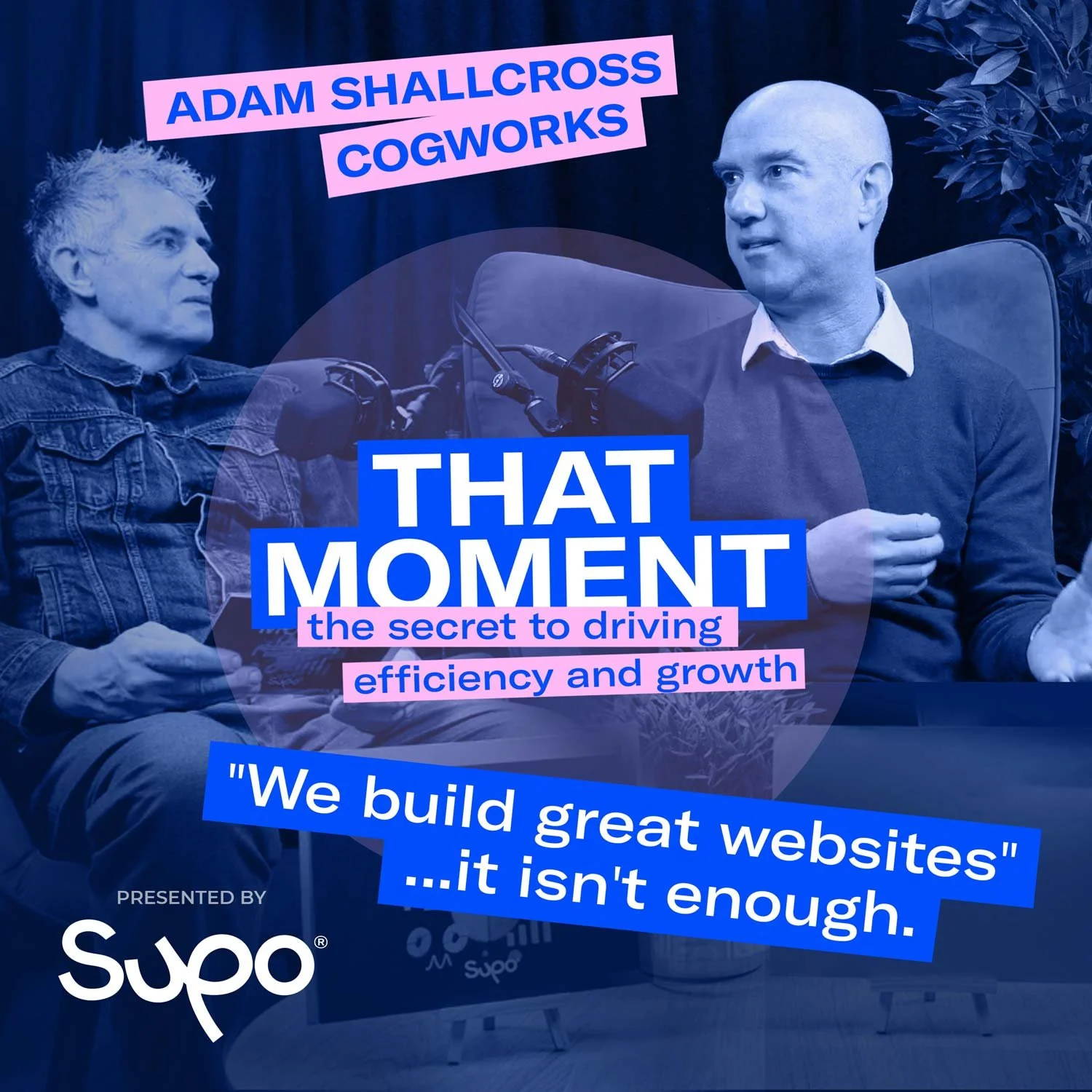
"We build great websites" ...it isn't enough - Adam Shallcross, Cogworks
Episode 14 - THAT MOMENT
What happens when you spend 18 years building brilliant websites, become an Umbraco Platinum Partner, help grow a global community from 70 people to thousands, and then realise nobody cares because every other agency is saying the same thing?
Adam Shallcross knows that feeling intimately. He founded Cogworks in 2006 with two mates, discovered Umbraco in 2008 when it was a tiny Danish open-source project, and rode that wave to become one of the UK's first certified partners. He started the London Umbraco meetup. He launched the UK Umbraco Festival. He built a reputation on technical excellence and open-source values.
But as the market grew from a handful of UK partners to over 100, leads stopped coming in. He had the realisation saying "we build great websites" meant nothing when a thousand other agencies said exactly the same thing.
Adam spent two years wrestling with what made Cogworks actually different. The answer wasn't in the services list. It wasn't in technical capabilities. It was in something he'd been doing all along without recognising it as the value proposition: solving problems.
The breakthrough came from stepping back and asking a harder question. Not "what do we do?" but "why do clients actually hire us?". The website is just the end product. It's the solution, not the problem. Clients don't wake up thinking "I need an Umbraco site". They wake up thinking "our editors waste hours on inefficient processes," or "our CRM and analytics don't talk to each other," or "we need to generate more qualified leads." Adam realised Cogworks had always been solving those problems, they just weren't positioning themselves that way.
This realisation led to Orama Studio, a pre-built back office for professional services firms that cuts development time in half whilst keeping the front-end completely bespoke. It led to consulting work helping Prostate Cancer UK cut hosting costs by 85% whilst dramatically reducing environmental impact. It led to a fundamental repositioning from "we build websites" to "we solve problems, and it happens that 99 times out of 100, the solution involves a website".
This episode tackles the question every agency founder eventually faces: how do you discover what actually makes you valuable? And why does the answer usually involve recognising what you've been doing all along?
The 18 year awakening:
The freelance collective origin: How three mates picking up clients from a failed agency became a limited company three months later with no grand vision.
The Umbraco discovery moment: Finding an open-source Danish CMS in 2008 that matched exactly how they wanted to build, throwing away their own CMS overnight.
Community as culture: Starting London meetups, launching UK Umbraco Festival, watching it grow from 70 to thousands, then giving it to the community after a decade.
The competition reality check: When the market exploded from 3 UK partners to over 100, "we build great websites" became meaningless differentiation.
The two-year wrestling match: Rewriting services lists, doing LinkedIn research, studying value propositions, forcing the uncomfortable question: what do we actually do?
The consultancy realisation: Recognising that solving efficiency problems, connecting disparate systems, and understanding client needs was the real work, websites were just outcomes.
Key Insights Uncovered:
Why Adam doesn't enjoy the HR and finance side of running an agency but loves talking to clients, finding problems, designing solutions, that's pure consultancy.
How Orama Studio works: pre-built professional services back office with no front-end, allowing parallel UX/design work whilst clients populate content in days not months.
The Prostate Cancer UK transformation: using Azure container apps that power down when not in use, cutting costs 85% whilst dramatically reducing carbon footprint.
Why professional services sites follow identical patterns (people section, thought leadership, services, navigation between specialists and expertise) making them perfect for systematisation.
The dangerous comfort of "we all build good websites" when differentiation requires understanding the actual problems clients face before they articulate technology solutions.
How sitting between marketing teams and infosec/DevOps gives agencies a higher-level organisational view than people inside the company, revealing connection opportunities nobody else sees.
Why Adam uses multiple AI tools to mark each other's homework, writing prompts in one LLM then asking another to critique it, creating friction that surfaces better solutions.
The sustainability calculation: Cloudflare reducing server load doesn't just save money, it dramatically cuts electricity consumption and data centre cooling requirements.
From Adam's perspective as someone who's always been interested in consulting but got buried in day-to-day agency operations, witness how the pressure of declining leads forced clarity. When necessity demanded better business development, surface-level answers (better marketing, more networking) weren't enough. The real answer required excavating 18 years of work to find the pattern: they'd always been problem-solvers who happened to build websites, not website-builders who sometimes solved problems. That distinction sounds semantic until you realise it changes everything about positioning.
Adam shares his philosophy on AI adoption: "It's an augmentation rather than a replacement. Some tasks will be replaced, they already have been, like meeting note-takers. But it's not replacing me as a person because I'm not a professional note-taker." He sees AI as a probability engine, not intelligence, useful when you remember it's predicting based on patterns, not thinking deeply. That scepticism keeps him grounded whilst experimenting extensively with tools that change monthly.
This episode addresses the question every established agency wrestles with: when you've built something successful using one positioning, when your market floods with competition saying identical things, when leads dry up because everyone claims the same capabilities, how do you discover your actual differentiation? And why does the answer usually involve recognising the value you've been creating all along without naming it properly?
About Supo:
Supo provides people-first intelligence software for professional services firms, helping businesses maximise profit and motivate their people through powerful, AI-enabled business intelligence dashboards. By connecting over 500+ platforms and providing real-time data analysis, Supo helps firms make better data-driven decisions about their profit, projects, and people.
For more information about Supo: www.supo.co.uk
About Cogworks:
Cogworks is an independent digital product agency and Umbraco Platinum Partner based in London, helping B2B firms attract high-intent enquiries through strategy, design, and development. Founded by Adam Shallcross in 2006, the agency specialises in solving digital and operational problems for organisations across law, finance, SaaS, and mission-driven sectors. Their core work involves modernising legacy systems, automating content operations, improving accessibility and performance, and helping leaders understand how to apply AI without adding noise.
For more information about Cogworks: wearecogworks.com
Ready to discover why 18 years of building websites wasn't the value proposition, it was just the output? This episode isn't just about repositioning, it's about excavating the work you've always done to find what clients actually pay you for.