
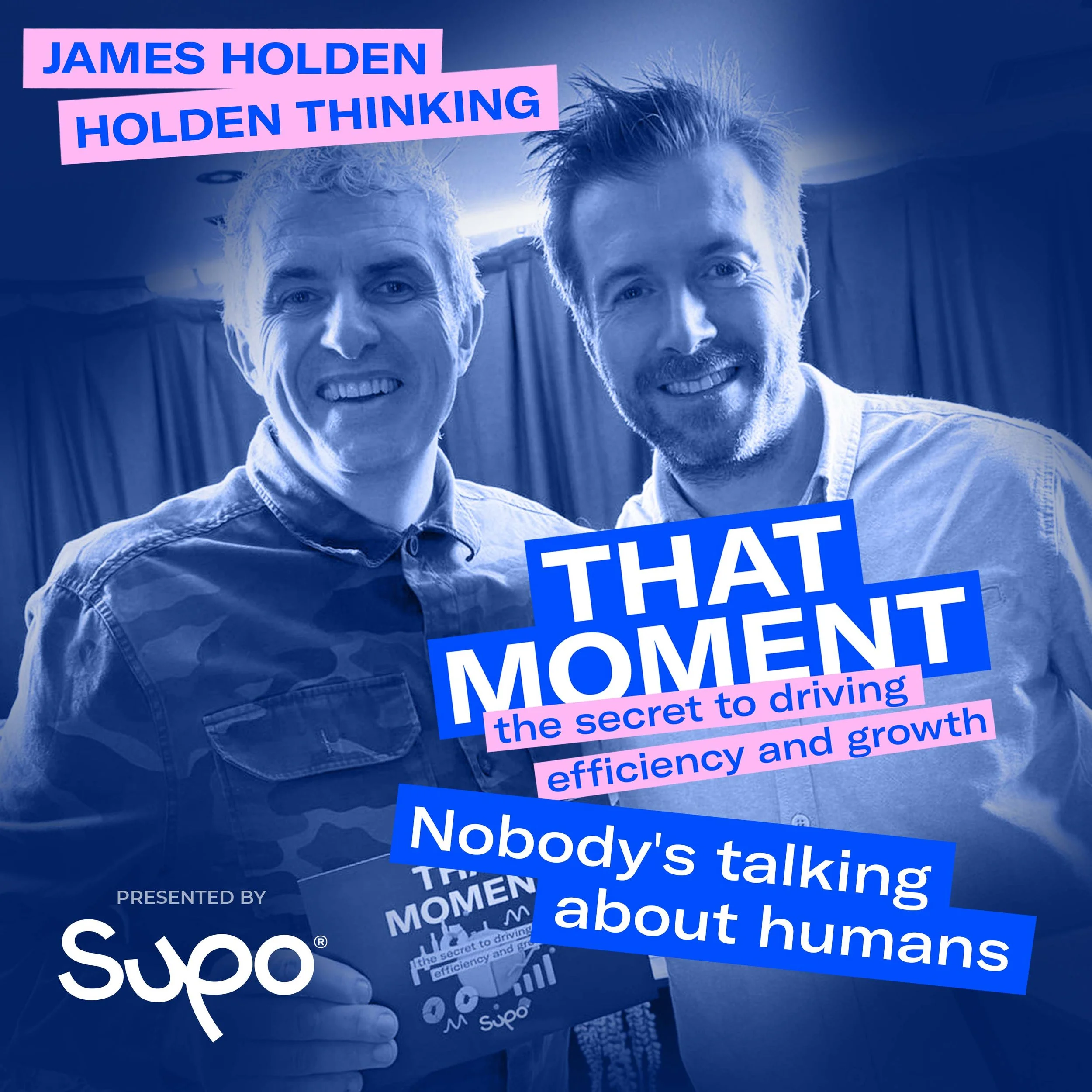
Nobody's talking about humans - James Holden, Holden Thinking
Episode 13 - THAT MOMENT
Everyone's obsessing about AI transformation… Which tools to use, which processes to automate, which competitors are moving faster…. But James Holden saw what everyone else was missing: it's not about the technology. It's about helping humans flourish alongside it.
After 15 years as a senior BBC Director - leading 100 staff, managing £25 million budgets, sitting on boards - he walked away at 50 to study organisational psychology. Not because the BBC wasn't brilliant. Because he realised his real passion was human behaviour, leading teams through change, helping people fulfil their potential. And the actual work was getting in the way.
Fast forward to 2025. James founded Holden Thinking and immediately faced a surge of demand he hadn't anticipated. Ten CEOs in a workshop room, all wrestling with the same challenge: how to transform their organisations with AI when their people are terrified. A session with 40 global Amazon leaders exploring what flourishing means as technology reshapes roles. NHS senior leaders navigating patient safety, data trust, and workforce resilience whilst AI accelerates change faster than anyone can track.
The pattern was clear. Whilst everyone was deploying technology, nobody was addressing the human side. Leaders knew they needed AI adoption but had no framework for the uncertainty their teams faced. Generic training wasn't working. Pan-organisational rollouts were failing.
A third of employees too embarrassed to admit they don't understand AI. Companies desperately don't want to lose their experts. The early majority realising "the time is now" but having no idea how to get their teams to the start line? - James was solving all of it through one fundamental insight: it's the uncertainty, not the change, that people struggle with.
This episode tackles the question every leader wrestling with AI faces:
- when your technical capabilities become table stakes.
- when your audience behaviours outstrip employee comfort.
- when the pace of adoption is so extraordinary that three-year plans become obsolete in six months.
Why does flourishing, not just coping, become the competitive advantage nobody else is building?
The human side nobody else was solving:
The BBC realisation: When digital consumption moved faster than staff confidence, curiosity alone wasn't enough without comfort.
The 50-year-old pivot: Walking away from board positions and £25m budgets to study organisational psychology because the machinery was getting in the way.
The techno-stress reality: Leaders aren't immune from fear of technology, the biggest challenge facing every CEO is taking their staff on the journey.
The flourishing definition: Staff who are engaged, have strong relationships, a sense of meaning in their work, and achieve realistic goals whilst feeling positive about themselves.
The ChatGPT speed problem: 100 million weekly users in two months versus the internet taking seven years, making strategic planning nearly impossible.
The psychological safety framework: Creating environments where people who are best at AI can put their hands up and say "I've got an idea" or "I don't think we're doing this right".
Key Insights Uncovered:
Why LinkedIn research shows half of workers feel AI is like taking on a new job, and a third are too embarrassed to admit they don't know enough about AI.
The study proving productivity doubles for people who've had full AI training versus those who haven't, yet vast swathes of organisations have done almost no training.
How training needs to be both role-specific and confidence-building, not generic "this is what ChatGPT does" presentations disconnected from actual work.
The study showing American physicians who spend just 10 hours weekly on tasks they enjoy or perceive as strengths have significantly lower burnout and quit rates.
Why it's not jobs disappearing but tasks within workflows being replaced, freeing people to do innovation, relationship-building, and creativity that gives meaning.
The Gen Z paradox: they're most likely to be involved in AI initiatives but least likely to admit embarrassment about not knowing enough, feeling pressure that their generation "should" be experts.
How the marketing industry is quite front-footed compared to sectors like health and social care, where staff feel less confident despite the opportunities.
The fundamental myth that AI will take everybody's jobs away when actually it removes repetitive tasks nobody enjoys, creating space for work that enables flourishing.
From James's perspective as someone who led teams through massive digital transformation at the BBC, he witnessed how audience consumption trends were moving faster than employee comfort created the pattern. Outstanding journalists excelling in their craft but uncertain about satisfying demand for different platforms and different audience needs. The dawning realisation: "Why don't I feel comfortable in this new world where so many of our audience are going, and have I got the right skills?".
James shares his philosophy on AI adoption: "It's less about AI. AI is the environment in which we currently live. But the goal to me is still about having staff who are flourishing in the workplace. Staff who are thriving, who are happy, who are doing a good job and fundamentally are both happy and feeling that the tasks that they do are linked to the values they have”.
This episode addresses the question every leader wrestling with transformation faces: when the pace is so extraordinary that certainty becomes impossible, when employees face unprecedented levels of fear and stress, when generic training fails and technology alone isn't the answer… how do you create conditions for people to flourish rather than simply cope? And why does psychological readiness matter more than technological capability?
About Supo:
Supo provides people-first intelligence software for professional services firms, helping businesses maximise profit and motivate their people through powerful, AI-enabled business intelligence dashboards. By connecting over 500+ platforms and providing real-time data analysis, Supo helps firms make better data-driven decisions about their profit, projects, and people.
For more information about Supo: www.supo.co.uk
About Holden Thinking:
Holden Thinking is a business psychology consultancy founded by James Holden in September 2025, enabling leaders and organisations to thrive through AI-driven change with a focus on culture, wellbeing, and the human side of transformation. After 15 years as a senior BBC Director leading teams of 100+ across marketing, audiences, and insight, James combines psychological insight, leadership experience, and strategic storytelling to help organisations navigate new ways of working as AI reshapes roles and expectations. He works with senior leaders across sectors from global media and technology to frontline public services, delivering workshops, coaching, and culture change advisory work. James holds an MSc in Organisational Psychology with Distinction from City, University of London, and is a member of the Association for Business Psychology.
For more information about Holden Thinking: https://www.linkedin.com/company/holden-thinking/
Ready to discover why AI transformation fails when you ignore the humans? This episode isn't just about technology adoption - it's about creating the psychological conditions for people to flourish in uncertainty rather than drown in it.