
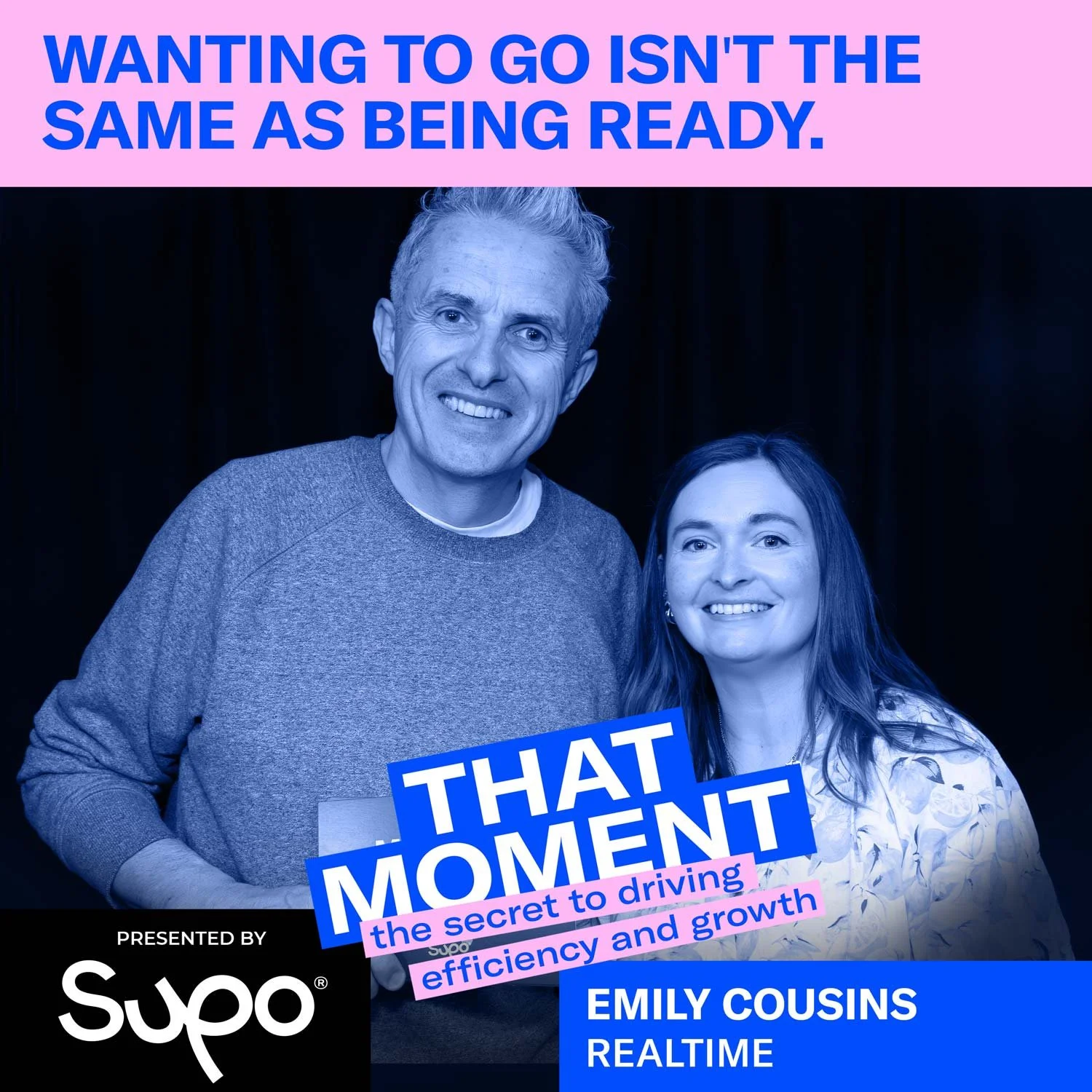
Wanting to go isn't the same as being ready - Emily Cousins, Realtime
Episode 32 - THAT MOMENT
How do you know it's time to leave a business you helped name?
Emily Cousins was employee number one at Realtime. She joined when it was two people planning in a café, stayed almost nine years, and helped take it to nearly 90 people and an acquisition in 2024. She describes herself as the risk-averse one in a partnership with a visionary founder, and says she still felt accountable for a business that wasn't hers. This conversation on That Moment is about what comes after the goal you built towards is achieved.
Employee Number One
Emily helped name the company. Day one was planning sessions in a café near her boss's house, and then straight into client work. With two people there was no such thing as a job description. She did whatever needed doing.
"You're kind of doing everything. Anything and everything that needs to be done."
The pressure of that role is unusual. You feel accountable for the success of the business, but ultimately it isn't yours. What made it work was that she and the founder had opposite strengths. He was visionary and confident, she was more risk averse and prioritised differently, and she challenged him on it. She says it felt more like a partnership than a boss-and-employee relationship, and that's why it lasted.
Family, Tribe, Village
Emily describes growth in three stages. In the early days it was a family, with no silos, everyone round one table and no "that's your job, not mine". Somewhere around ten to fifteen people it became a tribe. New external hires arrived, the founders stepped back from work they'd been doing hands-on, and structure and process started to replace chasing their tails.
Each stage asks something different of the people in charge. The habits that hold a family together don't scale, and the trick is knowing when to build structure without losing the culture that made the business worth building. Emily's view is that the earlier you build that visibility, the cheaper it is to fix problems.
Wanting to Go vs Being Ready to Go
The business was always meant to grow and be sold, and it achieved that in 2024. Emily says the aim being met didn't make leaving simple. She compares it to waving off a child at university: proud of what you've built, and painful to let go.
"Wanting to go can be quite an emotional thing. Whereas being ready to go is more of a practical thing."
Her point is that wanting to leave almost always comes first, and there's a period of processing before you're ready. Time away from the day-to-day gave her the perspective to work out what she actually wanted from her work. After nearly nine years in one business, she says she had lost some of the mission, and what she'd enjoyed most was navigating the growth stages. That became the direction for what she does next.
The People Side of AI
Emily now works with agency and service business founders on the same challenges she lived through. Founders are keeping the lights on while reinventing their businesses from the ground up, in a difficult economy, and it can be lonely. Her support comes in three parts: defining the value proposition, redesigning the operating model around AI rather than bolting AI onto old processes, and scaling people and culture.
"You're fundamentally selling people. You're selling relationships."
Her view runs against much of the noise. Everyone will be efficient with AI, she argues, so the value in a services business shifts even further towards people. Businesses may hire fewer people in some areas, but each hire matters more. She also thinks how we define scale will change. Headcount used to be the benchmark for a successful agency, and that's unlikely to hold. Most founders, she says, are feeling a little behind, and she expects the practical reality to catch up with the hype within the next 12 to 24 months.
The Hire That Taught Her to Be Decisive
Asked for a decision that caused stress at the time but proved right, Emily goes to hiring. She made a relatively junior hire early in her career, had doubts, and gave the benefit of the doubt. Within a couple of months it was clear the startup environment wasn't the right fit, and she made the hard call to part ways.
The difficulty was knowing where to draw the line. The more you've invested, the harder it is to stop. She says she has learned to be decisive, because in a small business each early hire has an exponential effect on the team and the culture.
Key Insights
Hire like every person defines the company. In a small team, early hires don't just do the work, they set the standard, and a wrong hire has an outsized knock-on effect
Partnerships work on opposite strengths. A visionary founder and a more cautious operator who challenges him. The challenge is what made it a partnership
Each stage of growth needs different habits. From family to tribe to village, the informal ways that work at five people stop working at fifteen
Wanting to leave and being ready to leave are different. The first is emotional and comes first, the second is practical and takes time
AI raises the value of people. Execution gets commoditised, so relationships, judgment and trust become the actual product
Scale is being redefined. Headcount used to signal success, and founders now need a different benchmark and an operating model built for AI
What This Actually Means
Emily's story is about the part of a founder-led business that gets less attention: the operator who builds the structure, holds the standards and carries the accountability without owning the outcome. Her leadership lesson is practical. Build the people side deliberately, be decisive when a hire isn't working, and treat AI as a reason to redesign the business rather than automate around it.
"I do think the people side of it is, if anything, going to become even more important."
About Supo:
Supo provides people-first intelligence software for professional services firms, helping businesses maximize profit and motivate their people through powerful, AI-enabled business intelligence dashboards. By connecting over 500+ platforms and providing real-time data analysis, Supo helps firms make better data-driven decisions about their profit, projects, and people.
For more information about Supo: www.supo.co.uk
About Realtime:
Realtime is a global digital marketing agency that began in performance and social advertising and grew into a full-service agency with teams across the UK, US and Asia. Emily Cousins was its first employee and helped scale it from a two-person start-up to nearly 90 people.
For more information about Realtime: https://realtimeagency.com/
Ready to hear what comes after the goal you built towards? Listen to Emily Cousins on That Moment.