
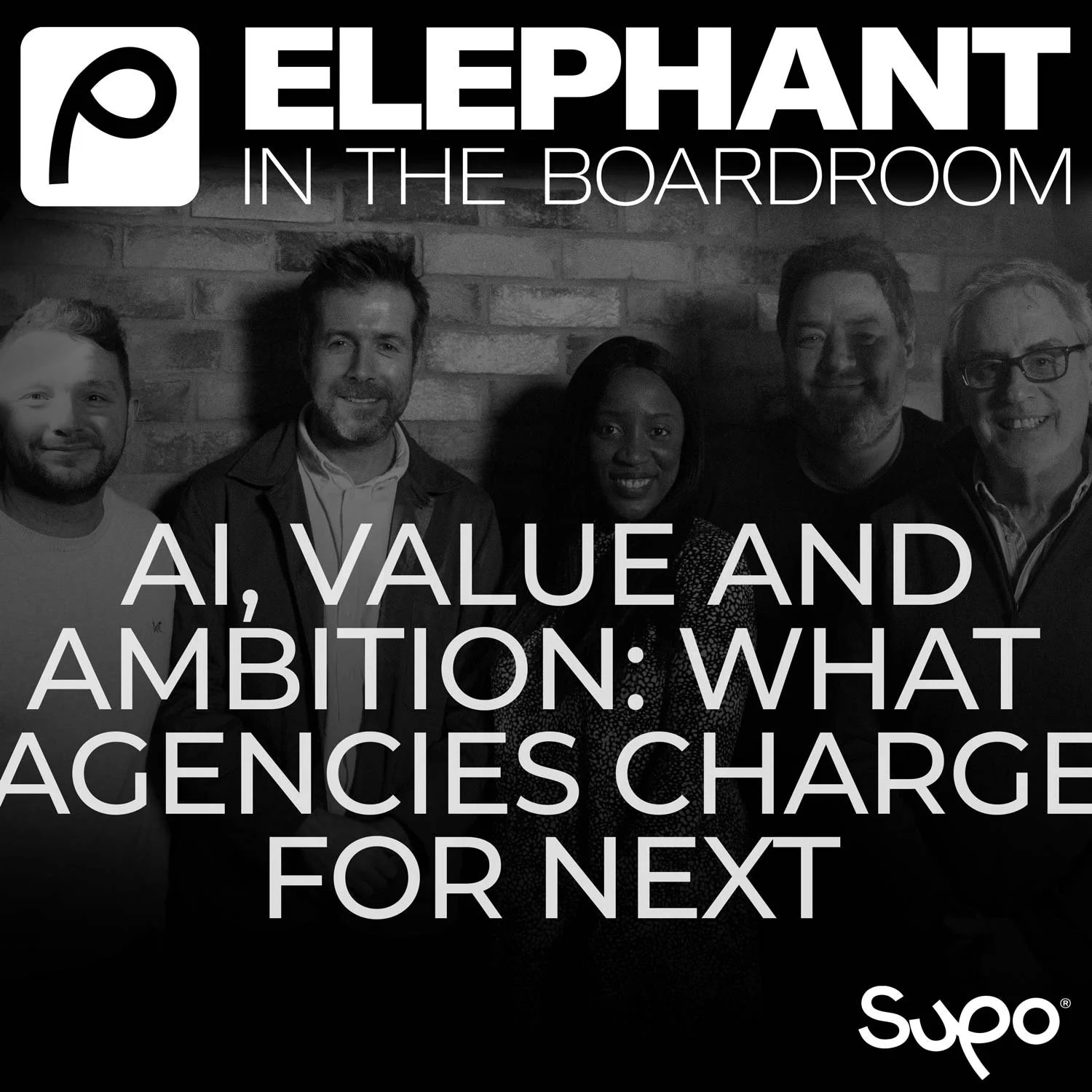
AI, VALUE AN AMBITION: WHAT AGENCIES CHARGE FOR NEXT - James Holden, David Finch, Simon Douglass, Lewis Wilkins
Episode 2 - ELEPHANT IN THE BOARDROOM
The question arrives quietly at first. Then it becomes deafening.
Agencies are delivering work faster than ever. Not because they've hired more people or worked harder. Because AI has fundamentally changed how work gets done. A task that took three days now takes three hours. A brief that required a week of research now needs an afternoon. Efficiency has skyrocketed.
But something else has happened alongside that acceleration. Vulnerability. Pressure. A creeping sense that speed isn't actually the answer - it's just made the problem more obvious.
David Finch, who advises agencies at board level, calls it the mindset shift nobody's making. James Holden, who works on leadership and culture, calls it an identity crisis. Simon Douglas, who runs a performance marketing agency and lives with this tension daily, calls it a market that's fundamentally changed. Lewis Wilkins, who's building a model that leans into AI rather than resisting it, calls it an opportunity nobody's taking seriously enough.
They all agree on one thing: the agencies that are hiding from this conversation are the agencies that are going to cease to exist.
The Speed Trap:
The problem starts innocently enough. AI makes work faster. Clients notice. They like it. But then the logic follows: if you can deliver this in half the time, shouldn't it cost half the price?
Lewis describes it as the "race to the bottom" - a perception that agencies are getting trapped in. Brands aren't spending the money they were five or six years ago. The pressure is real. The squeeze is felt. And the easiest narrative is to blame AI, when actually the problem is deeper.
Simon has lived this directly. Twelve years ago, he built a performance marketing agency selling SEO and PPC. That work was delivery-heavy. Today, AI has stripped away most of that delivery. The junior-level work that used to be the engine of growth has been automated. Clients that used to come in asking "I need PPC" or "I need SEO" don't ask that anymore. They either do it themselves or they look for something different.
The agencies that haven't adapted - that are still trying to sell the same delivery services in a world where machines do that work faster and cheaper - those agencies are genuinely vulnerable. But the vulnerability isn't really about AI. It's about refusing to ask a harder question: what are we actually selling?
The Mindset Shift Nobody's Making:
David frames it clearly: the challenge agency leaders have to ask themselves is, where are we going to be adding value in two, three, five years time? Because it isn't where we're adding value today.
This sounds simple. It's not. It's the difference between evolution and transformation.
Evolution is becoming faster at what you already do. Transformation is deciding what you're going to do instead. Most agencies are trying to evolve when they need to transform.
The old model was built on selling delivery. You have a problem, we deliver the solution. You need SEO, we do SEO. You need content, we create content. The value proposition was: we do this thing professionally and at scale. AI has made that proposition obsolete. Not because agencies can't do it well - they can. But because the client can increasingly do it themselves, or cheaper machines can do it.
Simon has already made this shift. He's no longer hiring at the junior level. He's no longer selling delivery. He's selling strategic thinking - the ability to look at a client's market, understand what's actually going on, and recommend an approach that works. The problem is that strategic thinking is harder to sell. It has a longer sales cycle. It requires deeper relationships. But it's also the only thing machines can't do.
James adds another layer: the leaders who built these agencies built them by being experts. By being the best at what they do. Suddenly they're in an environment where they simply can't be the best at everything - because everything is changing too fast. That's not just a business problem. It's an identity problem.
The Leadership Problem Everyone's Avoiding:
The hardest shift happens inside the leader's head.
For decades, the path to running an agency was clear: become excellent at what you do, prove it, scale it, lead it. Expertise earned authority. Excellence earned leadership. The model worked.
Now? James says leaders need to throw off the superhero jacket. Your role isn't to be the best at AI. Your role is to get up to speed and enable your team to thrive. That's a fundamentally different job description. And for people who got where they are by being exceptional at their craft, that shift can feel like losing ground.
But the new version of leadership is about being a networked connector of ideas and resources. Your job isn't to have all the answers. Your job is to create an environment where your team can find answers together. You set the vision - this is where we want to be in two, three years. But the answer to how you get there almost certainly won't come from you personally.
This requires psychological safety. It requires flat structures. It requires leaders to be comfortable saying "I don't know, but let's figure this out together." For leaders who built their authority on knowing more than everyone else, that's genuinely difficult.
Lewis has lived this shift. His approach to leadership has fundamentally changed. The top-down, expert-knows-best model doesn't work anymore. What works is creating the environment where ideas emerge from anywhere, where people feel safe to challenge the status quo, where experimentation is encouraged and failure is learning.
What Agencies Charge for Next:
This is the question that sits underneath everything. If agencies can't charge for delivery anymore - because AI makes delivery cheap and fast - what are they actually going to charge for?
David is clear: it's not about going faster. It's not about becoming more efficient. It's about actually adding value over and above where you were adding value today. That's a different conversation with clients. It's a different pitch. It's a different business model.
Simon's experience shows what this looks like: strategic thinking. Understanding market dynamics. Seeing around corners. Recommending approaches based on real insight rather than just executing requests.
Lewis believes the opportunity is in the agencies that lean into AI rather than resisting it. That don't see AI as a threat to their value but as a tool that amplifies what their team can do. The agencies that use AI to think more, to explore more, to go wider before they go deep.
James suggests the value is in human understanding - how you make people feel, what creates psychological safety, how you build teams that can navigate uncertainty together.
None of this is cheap. None of this is fast to sell. But all of it is genuinely valuable in a world where speed is no longer scarce.
The Agencies That Will Survive:
There's a through-line connecting all of this. The agencies that are going to survive the next five years aren't the ones that become slightly more efficient. They're the ones that:
Make the mindset shift. They stop selling delivery and start selling value. They understand that their competitive advantage isn't in being faster - it's in being smarter about what to do first.
Create leadership transformation. They recognize that being an expert isn't enough anymore. Leaders become connectors, enablers, creators of environments where thinking can happen at scale.
Lean into AI rather than hide from it. The agencies that are hiding it are the agencies that are going to cease to exist. The ones that adopt it, understand it, and use it to amplify human thinking - those are the ones that will thrive.
Charge for ambition, not hours. The old model was time-based. Hours times rate equals fee. The new model is value-based. What's the outcome? What's the transformation? That's what clients are willing to pay for.
About Supo:
Supo provides people-first intelligence software for professional services firms, helping businesses maximize profit and motivate their people through powerful, AI-enabled business intelligence dashboards. By connecting over 500+ platforms and providing real-time data analysis, Supo helps firms make better data-driven decisions about their profit, projects, and people.
For more information about Supo: www.supo.co.uk
About David Finch - Thinking In Fields:
David Finch advises agencies at board level through Thinking In Fields, bringing 20+ years of experience helping agency leaders navigate strategic transformation. His expertise sits at the intersection of business strategy, digital transformation, and the changing agency model. David works with agencies on the fundamental question: where is your value going to come from in a world where your current value proposition is becoming commodified?
For more information about Thinking In Fields: https://www.thinkinginfields.com/
About James Holden - Holden Thinking:
James Holden runs Holden Thinking, working with leadership teams on culture, identity, and navigating uncertainty. He specialises in helping leaders understand how their own identity shapes their agency, and how to evolve both when the world around them shifts fundamentally. His work addresses the psychological dimension of business transformation - the part most leaders avoid.
For more information about Holden Thinking: https://www.linkedin.com/company/holden-thinking/
About Simon Douglas - Curated:
Simon Douglas runs Curated, a performance marketing agency specialising in SEO, PPC, and content. With 12 years of direct experience watching AI change what agencies can charge for and what clients actually want, Simon is living the tension between the old delivery model and the new value model. His agency is actively pivoting from delivery-heavy work to strategic thinking and client outcomes.
For more information about Curated: https://curated-digital.com/
About Lewis Wilkins - Future Strategy Club:
Lewis Wilkins founded Future Strategy Club, building a model that leans into AI rather than resisting it. His perspective is that the opportunities created by AI adoption are far larger than the threats - but only if agencies are willing to rethink what they're actually building. He works with agencies on AI strategy and how to use AI to amplify human capability rather than replace it.
For more information about Future Strategy Club: https://www.futurestrategy.club/
The agencies that will charge premium fees in five years aren't the ones that become faster at what they already do. They're the ones that fundamentally transform what they do, how they lead, and what their clients are actually paying for.