
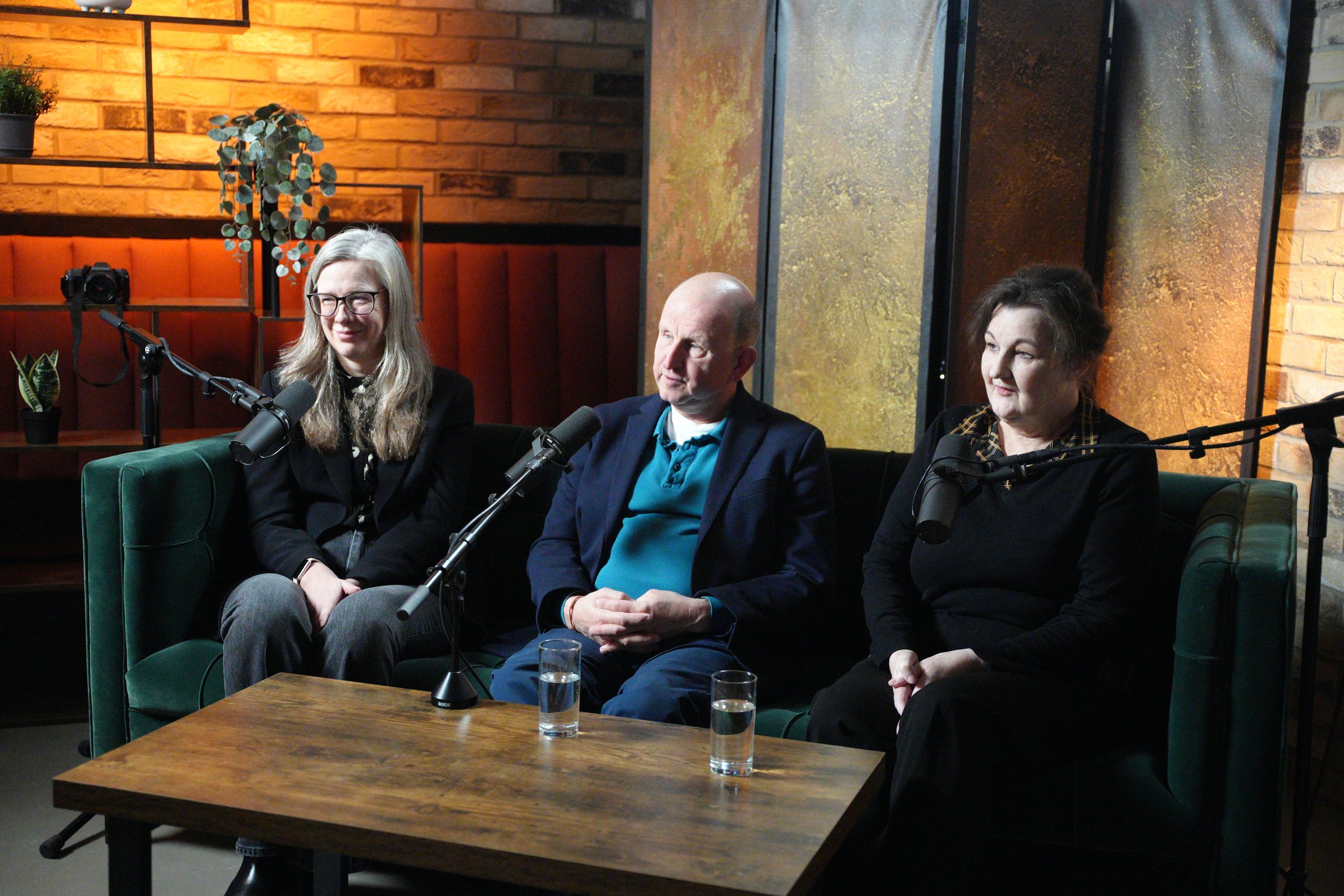
AMBITIOUS AGENCIES: rebuilding confidence, risk and momentum - Sarah Vick, Simon Rhind-Tutt, Joanna Anthony
Episode 3 - ELEPHANT IN THE BOARDROOM
Agency leaders are built for optimism. It's in the DNA. Walk into any pitch presentation and you'll see it: the belief that this agency can solve anything. The energy. The hunger. The confidence that borders on audacity.
But the last few years have worn that down in ways that aren't always visible. The roller coaster didn't just go higher and lower - the highs and lows became exceptional. Unprecedented. And somewhere in the middle, something shifted.
Confidence took a hit.
That's the reality Sarah Vick hears in every boardroom she sits in. Sarah is a chair and non-executive director who's spent 20+ years helping creative and technology businesses define and deliver growth strategies. She's seen what happens when the fundamentals crack. When boards stop planning for growth and start planning for survival. When ambition gets replaced by anxiety.
But here's what Sarah is also seeing now, in early 2026: something is shifting again. Not back to where it was. Something different. More realistic. More grounded. "The highs and lows have been exceptional," she says. "We're used to living on the roller coaster now. Some things are getting better."
That's not naive optimism. That's exhaustion turning into acceptance, which is often the first step toward genuine resilience.
The Difference Between Confidence and Ambition
When people talk about rebuilding ambition in agencies, they usually mean one thing: growth targets. Get back to 20% revenue growth. Win bigger clients. Expand headcount. Get to profitability again.
But that's not what Sarah, Simon Rhind-Tutt, and Joanna Anthony are talking about.
Simon is co-founder of Relationship Audits, a consultancy that's spent nearly three decades helping businesses understand the quality of their client relationships. He's got data from thousands of agencies. He's seen what actually drives sustainable growth - and what drives agencies into walls.
Joanna is a fractional operations leader and, more importantly, the co-founder of The Client Impact Awards - a recognition programme she created specifically because client service teams were being made redundant during tough years, their value treated as intangible and therefore disposable. She knows how agencies actually make money. And she knows that most of them don't realise where the money actually comes from.
Together, these three are pointing to something uncomfortable: agencies don't have an ambition problem. They have a confidence problem. And confidence comes back when the fundamentals are right.
"Ambition doesn't start with growth targets,"Sarah says. "It starts with belief."

The Uncomfortable Conversation About Planning
One of the most revealing moments in conversations with agency leaders, Sarah notices, is when she asks about their business plan. Some laugh. Some groan. Some say things like: "Do we really have to write one? It's like gazing into a crystal ball."
But here's what happens in the boardrooms where plans exist - and where those plans are shared with the whole team: different outcomes.
"People need something bigger to buy into,"Sarah explains. "Otherwise you're just a member of staff turning up, doing your 9 to 5, and going home. You get less churn if people have that vision they're buying into."
The key word is shared. Not hidden in the boardroom. Not whispered to leadership. Written down. Articulated in a way that's meaningful for individual staff members. "What does this mean for me? How do I contribute to this vision?"
It sounds obvious. It's not. Most agencies don't do this.
And the business plans that do exist have shifted dramatically. A few years ago, the default was always the same: "We're going to grow by 20 to 30%." It was almost a template. It didn't matter if it was realistic. It was the number you put in.
Now there's scrutiny. Real scrutiny. "What's real? What can we actually achieve as a team of people? What's realistic?"Sarah sees agency leaders asking harder questions. And the plans that come out of that are better. Not because they're more conservative. Because they're credible.
Credible plans rebuild confidence.
The Client Service Trap
Here's where Joanna's work becomes crucial.
When agencies got lean - when the pressure came on and every line item got questioned - one role disappeared first: client service leadership. The account directors. The people who actually held the relationship together.
Why? Because their value is intangible. You can measure creative output. You can measure media spend efficiency. You can measure project delivery. But relationship building? Trust? The conversations that happen between projects? That's harder to quantify.
So it got cut.
"It was an easy headcount to lose,"Joanna explains. "But that's short-term gain for long-term loss."
What agencies didn't realize - what they're realizing now - is that client service isn't a cost. It's where growth actually happens. Not in new business pitches. In expanding relationships with the clients you already have.
Simon's data backs this up.
"We estimate that acquiring a new client is 20 times harder than growing an existing one. Yet most companies still treat retention as an afterthought."
Think about that. Twenty times harder.
And yet the business plans still focus on new business. The resources still go to new business. The celebration still happens when a new logo shows up on the client list - but when an existing client gives you a second piece of work, that barely registers.
"Your existing clients are on somebody else's new business list,"Simon says. "You've got to show the client love. You've got to deliver. Because if you can secure that base, it's a much better way to actually grow your business."
The Wooly Words Problem
One of Simon's favourite experiments comes from a conference he chaired. He asked seven procurement buyers to write down their definition of "value."
He got five different answers.
Five different definitions of the word that's supposed to anchor the entire client-agency relationship.
That's the wooly words problem. "Quick." "Creative." "Strategy." "Value." They all mean different things to different people. And if a client and an agency have different definitions of value, they're not actually talking about the same thing.
"One dimension is cost,"Simon explains. "The other is the value you bring to the business. Then there's sales results. The quantification of your outputs into business success. Those were the two ends, and there were variations in between."
So an agency walks in thinking they're being "strategic" when the client thinks strategy means "faster and cheaper." The agency talks about "creative excellence" when the client cares about "business impact." They're both using the same words. Neither one understands what the other actually means.
Joanna sees this constantly. Clients come in asking for an agency to understand their business better. But what does that actually mean? Does it mean reading the annual report? Understanding the organizational silos? Knowing the CEO's strategic priorities? Knowing how to translate creative work into terms the CFO will care about?
"The best client relationships aren't built on service,"Joanna says. "They're built on partnership. And partnership means understanding the client's world - not just the project they've briefed you on."
Calculated Ambition Rather Than Risk
Here's where the episode title becomes important: ambitious agencies aren't the ones taking reckless risks. They're the ones being calculated.
Simon learned this decades ago when he ran a design agency that got a reputation for being the angry young boys of the industry - creative, brilliant, pushing boundaries.
But they had a system.
"We presented a safe option, one in the middle, and one pushing the boat out," he remembers. "And often we'd say, 'We've got one in the bag - that's probably too creative for you.' And they'd say, 'You know what, let's do that one.'"
The Tango packaging redesign. Revolutionary. Brave. Effective. But it wasn't reckless. It was calculated ambition - understanding where the client's boundaries actually were, and then gently moving them.
That's what rebuilding confidence looks like in practice. Not killing the ambition. Recalibrating it. "It needs to be a calculated ambition rather than risk,"Simon says.
And that only happens when you've done the work to understand what the client actually values. When you've listened to what they're saying - and what they're not saying. When you've read the chairman's statement and understand where the business is actually trying to go.
Joanna builds on this.
"Clients are increasingly looking for something brave that's going to move the needle. But there's an awful lot that's unsaid in the brief. There might be a very big, hairy goal sitting at the end of it. Really digging into the brief - knowing how to unpick it - that's when you can figure out how far you can actually go."
The Real Work Starts With Existing Clients
So if ambition comes back through confidence, and confidence comes from credible plans and real client partnerships - where does an agency actually start?
All three of them point to the same place: your existing clients.
Not the pitch pipeline. Not the new business targets. The relationships you already have.
Sarah's advice is direct:
"Have a plan. Write down your plan. Share that with all of your staff. Make sure it has a clear vision. Who do you want to work with? Who don't you want to work with? What do you want to achieve?"
Simon's is equally clear:
"Start with your existing or recently lapsed clients. Those are the easiest to convert because there is already a relationship."
Joanna's is about the mindset:
"Remember your passion. Remember why you're actually doing this. If you're trying to run your business in fear, you're going to keep bumping into mistakes. You'll generate an environment of psychological safety where people will be fearful. But if you walk in the door with a big cheery smile and remember the passion of what you're doing it for, that will infect the entire business."
It's not cynical. It's not motivational-poster thinking. It's practical. Existing clients trust you. They know your work. They're not on someone else's new business list yet. They're on yours. Protect that.
From there, growth comes naturally.
The Next 12 Months
If you're an agency leader reading this, trying to figure out how to rebuild ambition, here's what the three of them would tell you:
First: Have a realistic plan and share it. Not a fantasy. Not a hope. A plan that accounts for the people you have, the clients you want, the margins you need. Articulate it in a way that makes sense for every single person in your business.
Second: Invest in your client relationships. Stop treating client service as a cost centre. It's where growth actually comes from. Measure it. Make it visible. Celebrate it the same way you celebrate new business.
Third: Stop chasing new clients before you've looked after the ones you have. Twenty times harder to acquire. Why are you still optimizing for that?
Fourth: Get clarity on what you actually mean by the words you're using. What does "value" mean to your client? What does "creative" mean? What does "strategy" mean? Have that conversation before the project starts, not after.
Fifth: Remember why you started. Not the revenue target. Not the exit plan. Why you actually wanted to do this work.
Because ambition without belief is just a spreadsheet. And confidence without passion is just risk management.
The agencies that rebuild ambition in the next 12 months won't be the ones that grow fastest. They'll be the ones that grow with intent. With belief. With a team that actually understands where they're going and why.
About Supo:
Supo provides people-first intelligence software for professional services firms, helping businesses maximize profit and motivate their people through powerful, AI-enabled business intelligence dashboards. By connecting over 500+ platforms and providing real-time data analysis, Supo helps firms make better data-driven decisions about their profit, projects, and people.
For more information about Supo: www.supo.co.uk
About Sarah Vick:
Sarah Vick is a chair and non-executive director specialising in supporting creative and technology businesses to define and deliver strategic growth plans. With more than 20 years of global leadership experience, she helps agencies navigate growth, scaling, operational improvement, international expansion, and M&A. She speaks regularly on finance for agencies, career development, and the role of gratitude in business success, and brings a sharp financial lens to the ambition conversation.
For more information about Sarah Vick: https://www.linkedin.com/in/sarahvick/
About Simon Rhind-Tutt:
Simon Rhind-Tutt is co-founder of Relationship Audits, a consultancy that provides actionable intelligence on client-agency relationships built on millions of data points. Nearly three decades of experience have convinced him of one thing: business is built on relationships, and those relationships should be measured, understood, and continuously improved. His proprietary RADAR survey tool helps agencies and clients move beyond satisfaction scores to genuine mutual commitment.
For more information about Relationship Audits: https://relationshipaudits.com/
About Joanna Anthony:
Joanna Anthony is a fractional operations leader, strategic advisor, and co-founder of The Client Impact Awards, a recognition programme celebrating the account leaders and client service professionals who drive growth and build the partnerships that make great work possible. With over 30 years on agency boards, she specialises in designing the operational structures and relationship-building behaviours that make strategic partnerships actually work - and in proving that client service is a commercial asset, not a cost.
For more information about Joanna Anthony: https://joannaanthony.com/
Ambition isn't about pretending the last few years didn't happen. It's about deciding what kind of future you're willing to build anyway. It starts with belief, not targets. With partnerships, not pitches. With your existing clients, not the ones on someone else's new business list. That's how confidence comes back. That's how real growth happens.