
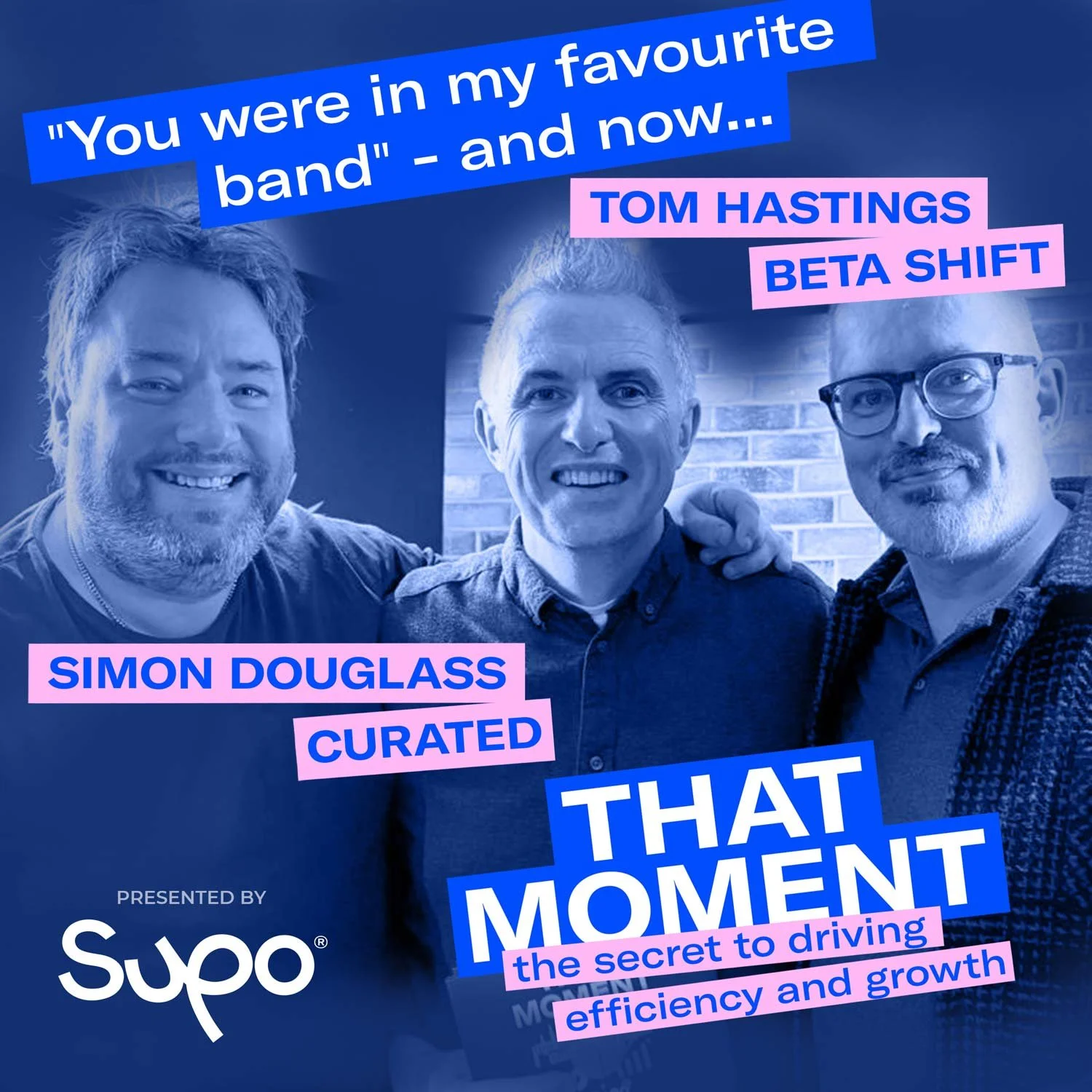
“You were in my favourite band” - and now… Simon Douglass, Curated & Tom Hastings, Beta Shift
Episode 12 - THAT MOMENT
Picture this: you're hiring someone for your agency. They casually mention they used to be in a band. You ask which one, expecting you've never heard of them. They name it. You say, "What? My favourite band." That's how Simon Douglass met Tom Hastings. Simon had seen Tom's band, Goldheart Assembly, perform live 4 or 5 times. He even had a video of Tom on stage saved on his phone.
Fast forward 11 years. Tom exits his performance marketing agency after scaling it from 5 people to 80+, opening a New York office, and working with some of the biggest names in live entertainment. He's on gardening leave, thinking about AI. First person he calls? Simon. Because whilst most people were still figuring out what ChatGPT meant for business, these two had been experimenting since its third birthday, building AI into processes, testing tools, making mistakes, learning what actually works.
When an agency approached them to help embed AI into their business, Simon and Tom had to make it up. There was no framework. Most AI training was generic, theoretical, disconnected from real work. So they built something different: bespoke programmes starting with questionnaires to gauge where teams actually were, moving through orientation, prompting, automation, and culminating in hands-on implementation. Three sessions with gaps between to iterate based on feedback. Practical demonstrations on real client examples, not abstract tutorials.
But here's what makes their partnership compelling: they approach everything differently. Simon is experimental, frivolous, "just get on with it" energy. Tom is structured, framework-driven, research-oriented. Simon gets bored with technical explanations. Tom loves talking about systems and frameworks. They've never disagreed on work decisions because they've found something rare, productive disagreement that doesn't produce conflict, just better outcomes.
This episode tackles the question every agency wrestling with AI faces: when the technology is moving faster than anyone can track, when tools multiply daily, when clients demand solutions before best practices exist, how do you build capability without overwhelming teams? And why does having two completely different perspectives create better training than either approach alone?
The Complementary Opposites Framework:
The Band Story Origin: How hiring your favourite musician creates psychological safety and trust that enables productive disagreement years later
The Generic Training Problem: Why most AI consultancy delivers theoretical overviews disconnected from clients' actual day-to-day work
Bespoke Over Scale: How spending more time customising training to specific client needs creates longer-term relationships and ongoing revenue
The Three-Session Iteration Model: Questionnaire, orientation, feedback, customise, deliver, iterate, creating programmes that evolve with client needs
Experimental vs Structured: Why Simon's "just demo it" approach balanced with Tom's frameworks creates better learning experiences
The Pacing Dance: How alternating between technical deep dives and quick practical demonstrations keeps energy up during hour-long AI sessions
Key Insights Uncovered:
Why AI isn't a silver bullet and most agencies need to step back, fix data transformation and automation foundations before layering AI on top
The shopping list hack that became everyone's favourite takeaway from Simon's British Library talk: using ChatGPT to organise unordered grocery lists by shop section
How AI note-takers like Fathom transformed Simon's meeting approach, removing the cognitive load of note-taking whilst remaining present in conversations
Why content automation and generation is overhyped whilst practical workflow improvements deliver actual value agencies can measure
The GDPR tension with AI note-takers: when clients see the bot recording and say "turn that off," you're back to manual notes
How Tom repositioned SEO as a core growth lever at SINE Digital, integrating it into live entertainment offerings and creating the 'Total Search' model
Why seeking alignment around AI strategy is premature when even Coca-Cola is still piloting systems in specific areas and many are failing
The rule Simon learned the expensive way: never pay annual subscriptions for AI tools, they'll be obsolete in a month
From Tom's perspective as someone who co-founded and scaled a performance marketing agency from band members to 80+ global team, witness how technical expertise matters less than understanding how to build systems around people. He'd been the singer and keyboard player's business partner, reuniting years after the band to build something bigger. When that chapter closed with a sizable investment and his exit, the AI opportunity wasn't about tools, it was about helping teams navigate transformation without the overwhelm most training creates.
Simon shares his philosophy on AI adoption: "AI isn't a silver bullet for everything. Just because AI is a big topic right now doesn't necessarily mean that as an agency, you have to jump onto that bandwagon and try to use AI to solve any issues." His technical partner spends most of his time convincing leadership teams not to use AI because they think they know what solution they need, when actually they need to take five steps back and fix data foundations first.
This episode addresses the question every partnership wrestles with: when you approach work completely differently, how do you create something better together than either could alone? And why does productive disagreement beat comfortable consensus when navigating technology moving faster than anyone can track?
About Supo:
Supo provides people-first intelligence software for professional services firms, helping businesses maximise profit and motivate their people through powerful, AI-enabled business intelligence dashboards. By connecting over 500+ platforms and providing real-time data analysis, Supo helps firms make better data-driven decisions about their profit, projects, and people.
For more information about Supo: www.supo.co.uk
About Curated:
Curated is a digital marketing consultancy founded by Simon Douglass in 2014. After repositioning in 2020 from traditional agency work, they focus on business goals through a three-stage strategy: Enhance (identify competitive advantage), Expand (understand customer needs), and Evolve (refine with customer experience focus). With 21 years of digital marketing experience including PPC, SEO, analytics, and content marketing, Curated offers consultancy from content strategy to SEO auditing. The agency now specialises in AI training and consultancy for marketing and PR teams, delivered by Simon and Tom Hastings, focusing on bespoke programmes tailored to specific client workflows rather than generic training.
For more information about Curated: https://curated-digital.com/
About Beta Shift:
Beta Shift is a growth marketing and AI consultancy founded and led by Tom Hastings, drawing on over 20 years of digital marketing experience including senior leadership in global agencies. The company helps brands adapt to the rapidly changing marketing landscape by integrating insights-led strategy with practical AI transformation and digital growth tactics. Its services span digital strategy, integrated search-everywhere optimisation, SEO, paid media, content engineering, data measurement, and tailored AI strategy and training, all designed around a client’s business reality rather than generic frameworks. Beta Shift works with marketing leaders, founders, and leadership teams through flexible engagements like fractional chief marketing leadership, project-based consultancy, strategic audits, and hands-on workshops. The firm emphasises using AI to enhance performance and sustainable growth, with bespoke solutions shaped to client workflows and goals rather than off-the-shelf models.
For more information about Beta Shift: https://betashift.ai/
Ready to discover why the best partnerships aren't built on agreement but on complementary strengths and productive disagreement? This episode isn't just about AI training, it's about recognising when opposing approaches create better outcomes than either perspective alone.